
Decoding toxic work culture through memes

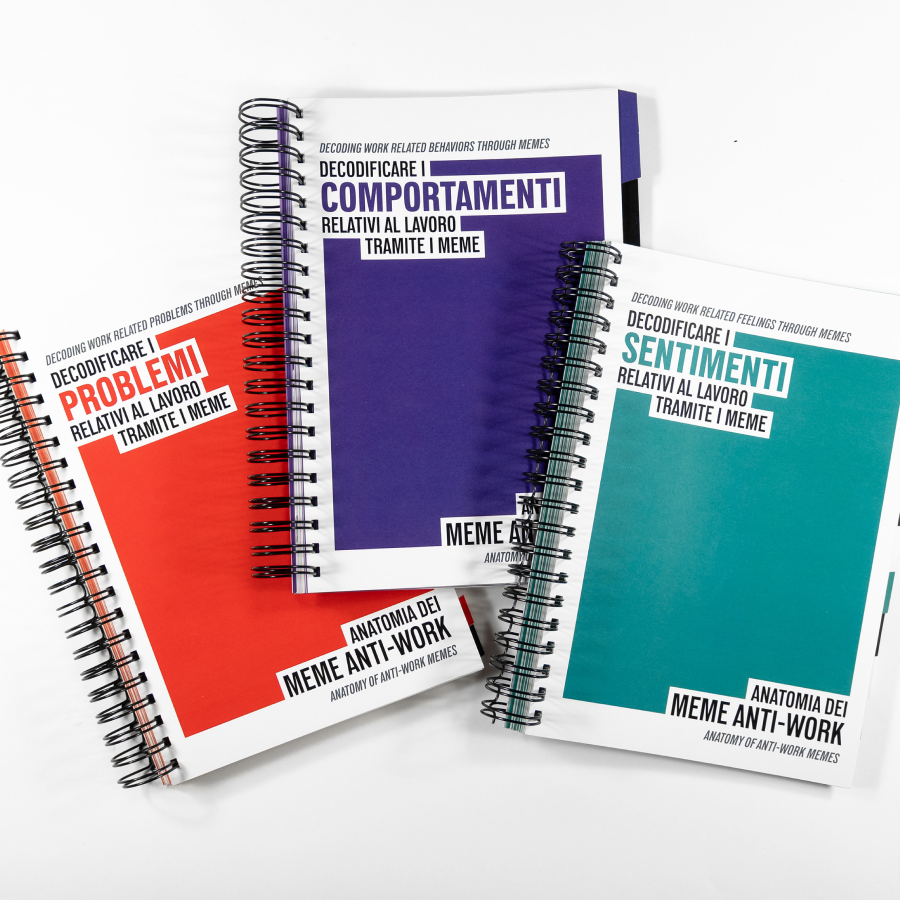
The project Anatomy of Anti-Work Memes analyzes memes as critical tools capable of making the toxicity of contemporary work culture visible. Through the collection, classification, and deconstruction of memes circulating online, the project investigates structural problems, recurring behaviors, and shared sentiments among workers, showing how these seemingly lighthearted contents become powerful instruments of cultural critique.
The project is developed primarily through three thematic catalogs that collect and interpret 167 memes, selected and analyzed through a process of visual and textual deconstruction. This approach makes it possible to highlight the different layers of meaning present in each meme.
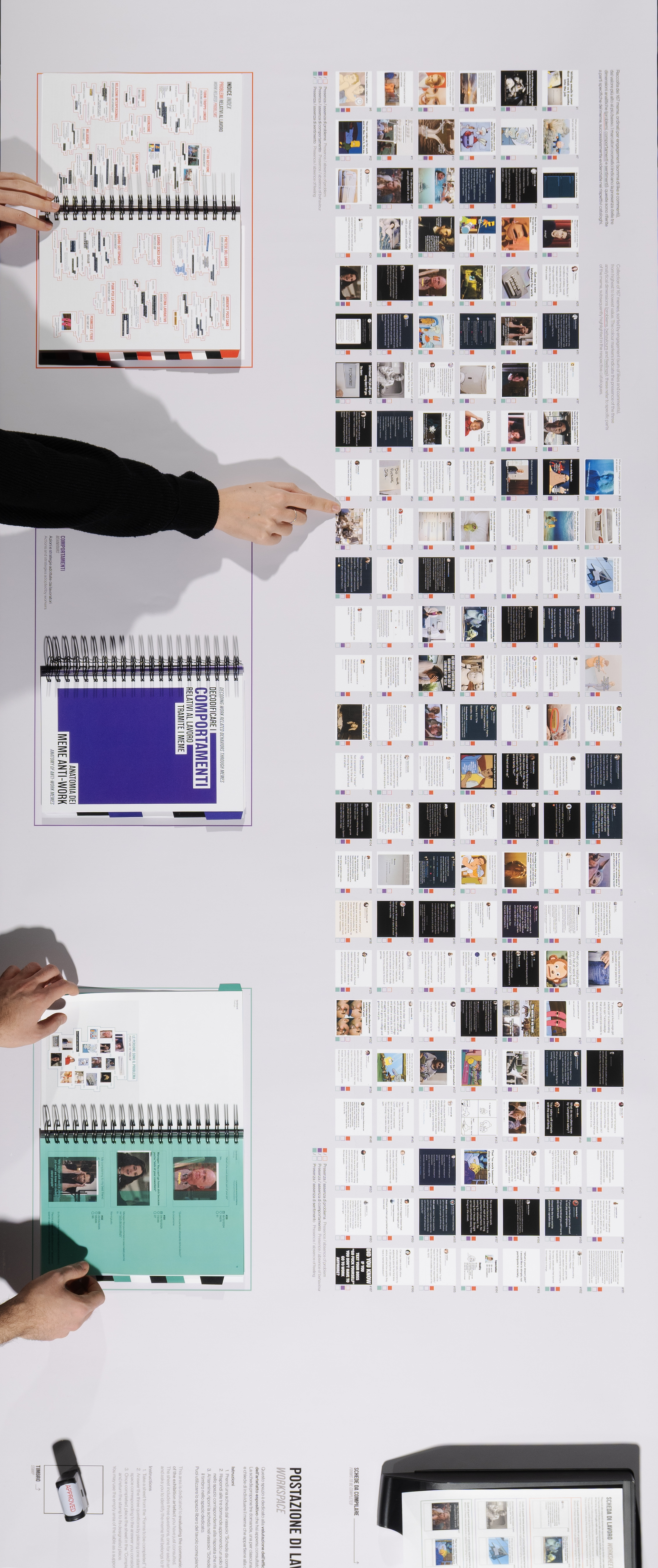
Overall view of the exhibition setup with the grid of the 167 memes and the three catalogs displayed on the table.
Data design
The dataset was constructed starting from the Instagram profile @antiworkmemes, considering content published between 2020 and 2025. The initial data collection, carried out on October 10, 2025, using Apify’s Instagram Scraper, produced a dataset of 600 posts, accompanied by their respective metadata. The contents were ordered based on the total number of interactions (calculated as the sum of likes and comments), from the highest to the lowest value. For the initial analysis, memes exceeding a threshold of 10,000 total interactions were selected, resulting in 204 posts. Subsequently, following the exclusion of duplicate and irrelevant content, the dataset was reduced to 167 memes. Each row of the dataset represents a single post, from #1 to #167; for each meme, the existing data were further supplemented with the image, the transcription of the text, and its translation into Italian.
The memes were analyzed by breaking down their textual and visual components, an operation that made it possible to identify three interpretative dimensions capable of describing the toxic culture of work: problems related to working conditions and dynamics, behaviors enacted by workers, and sentiments expressed in relation to their professional experience. For each dimension, the following columns were defined within the dataset:
- Presence or absence of the interpretative dimension in the meme;
- Textual and/or visual portion representative of the problem, behavior, or sentiment;
- Thematic affinity of the dimension: memes are grouped into 14 categories of problems, 6 of behaviors, and 11 of sentiments.
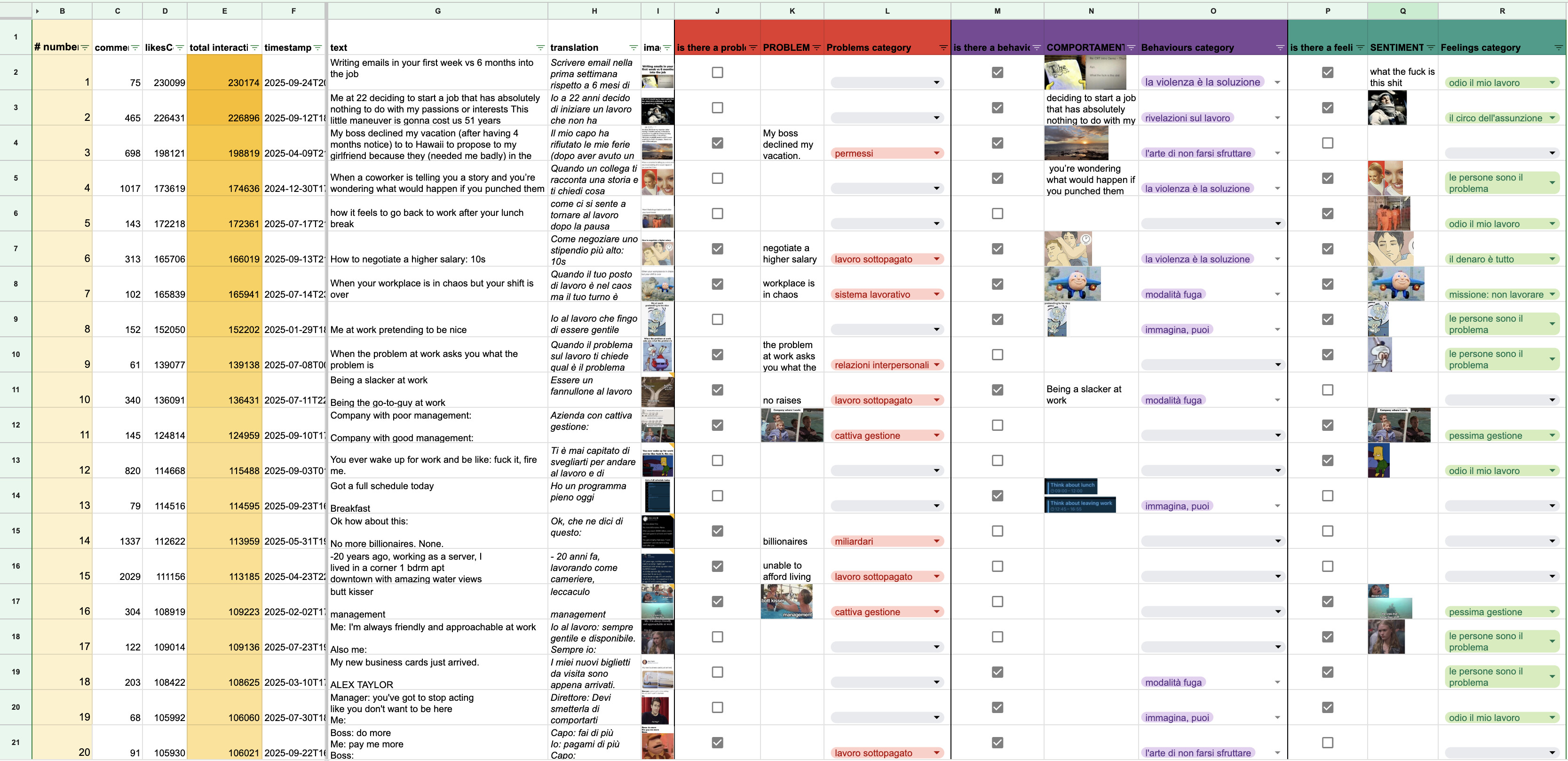
Project dataset
Interpretative dimensions
The categories related to problems describe the main critical issues of the labor system as they emerge in anti-work memes. They represent structural dysfunctions, abuses, contradictions, and inconsistencies in the organization of work, highlighting what makes the work experience toxic or unsustainable. Taken together, they provide a map of the recurring tensions that run through contemporary work.
The identified categories are: Overlong shifts, Poor management, Meetings, Hiring, Capitalism, Interpersonal relationships, Billionaires, Work demands, Unhealthy environment, Pointless work, Working system, Underpayment, Retirement plans, Paid time off.
The behavior categories represent the ways in which workers react to, resist, or adapt to problematic working conditions. Individual and collective strategies emerge, along with attitudes of detachment, irony, resignation, or opposition, showing how people deal on a daily basis with the toxicity of work and attempt to reconfigure their role within it.
The behavior categories include: Avoidance mode, Workplace revelations, Mission: survival, The art of not being exploited, Violence is the solution, Play pretend.
The feelings categories represent the emotional reactions associated with the experience of work as narrated in anti-work memes. Rather than classifying emotions in a psychological sense, these categories describe what the sentiments are directed toward: moments, dynamics, expectations, or working conditions. What emerges is a complex emotional landscape that highlights the affective—and often conflictual—relationship between individuals and work culture.
The identified categories are: People are the problem, It’s about money, Fuck capitalism, Mission: not working, Hiring circus, Lower your expectations, I hate my job, I don’t care about my job, Time trap, Burnout core, Poor management.
Experience
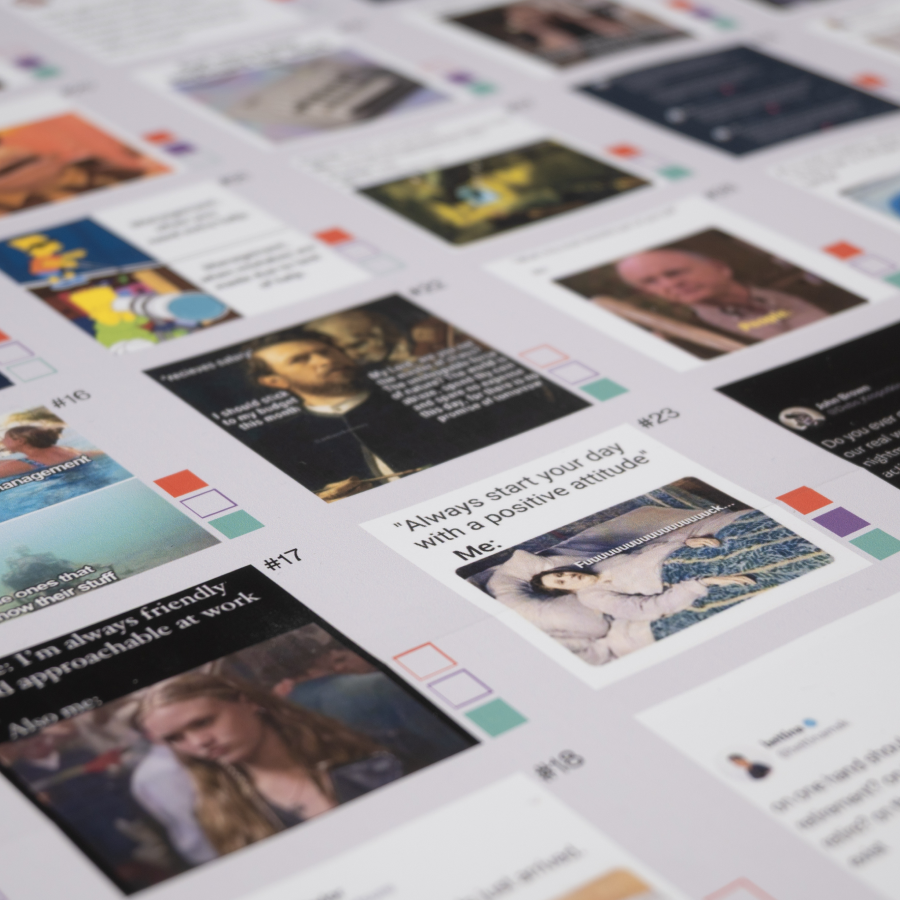
During the exhibition, the three catalogs are displayed on the table together with the grid presenting the 167 memes ordered by level of engagement. Each meme is marked with color-coded indicators that identify the dimensions present: problems (red), behaviors (purple), and feelings (green). The markers also indicate the inclusion of each meme within the respective catalogs.
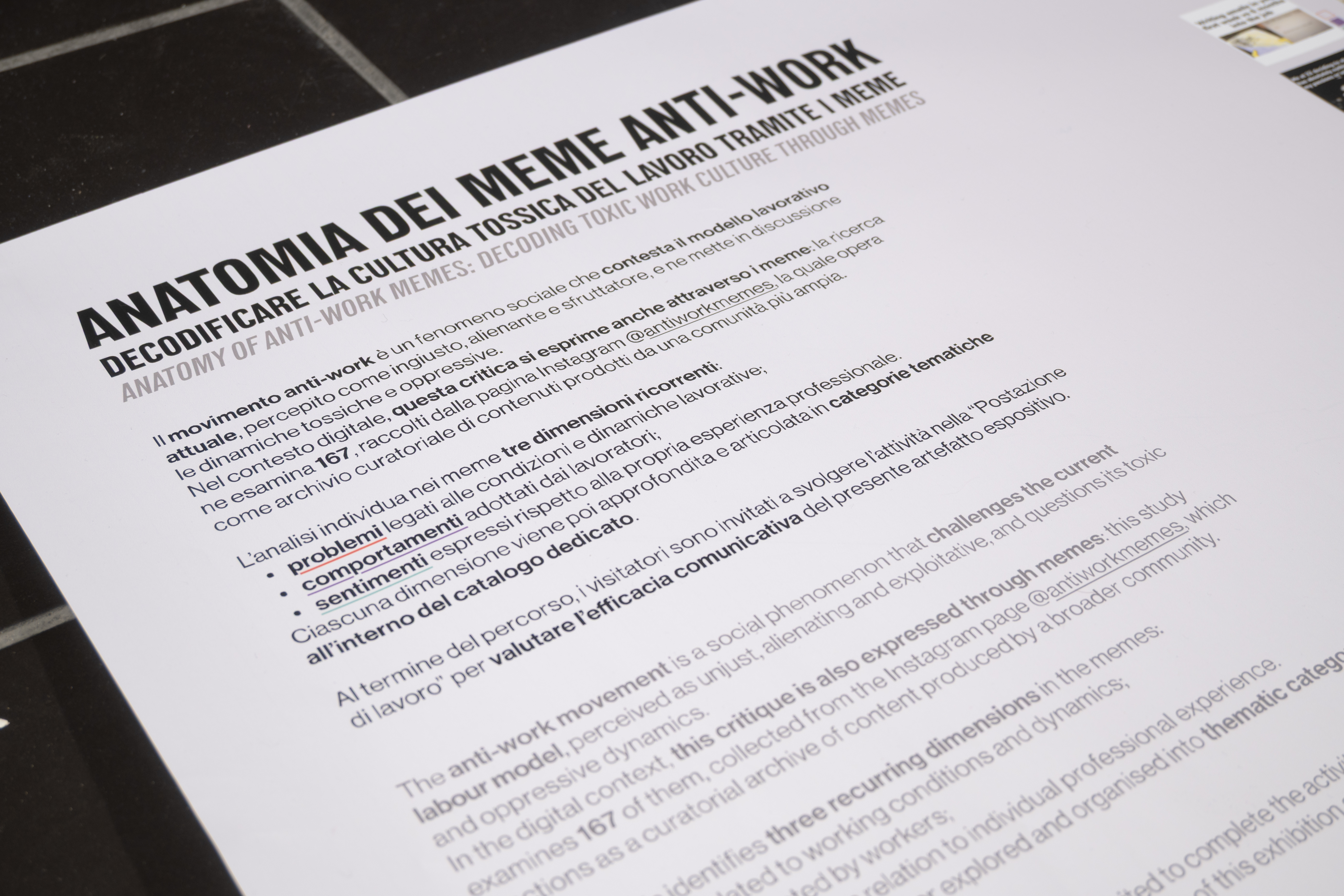
Exhibition introduction
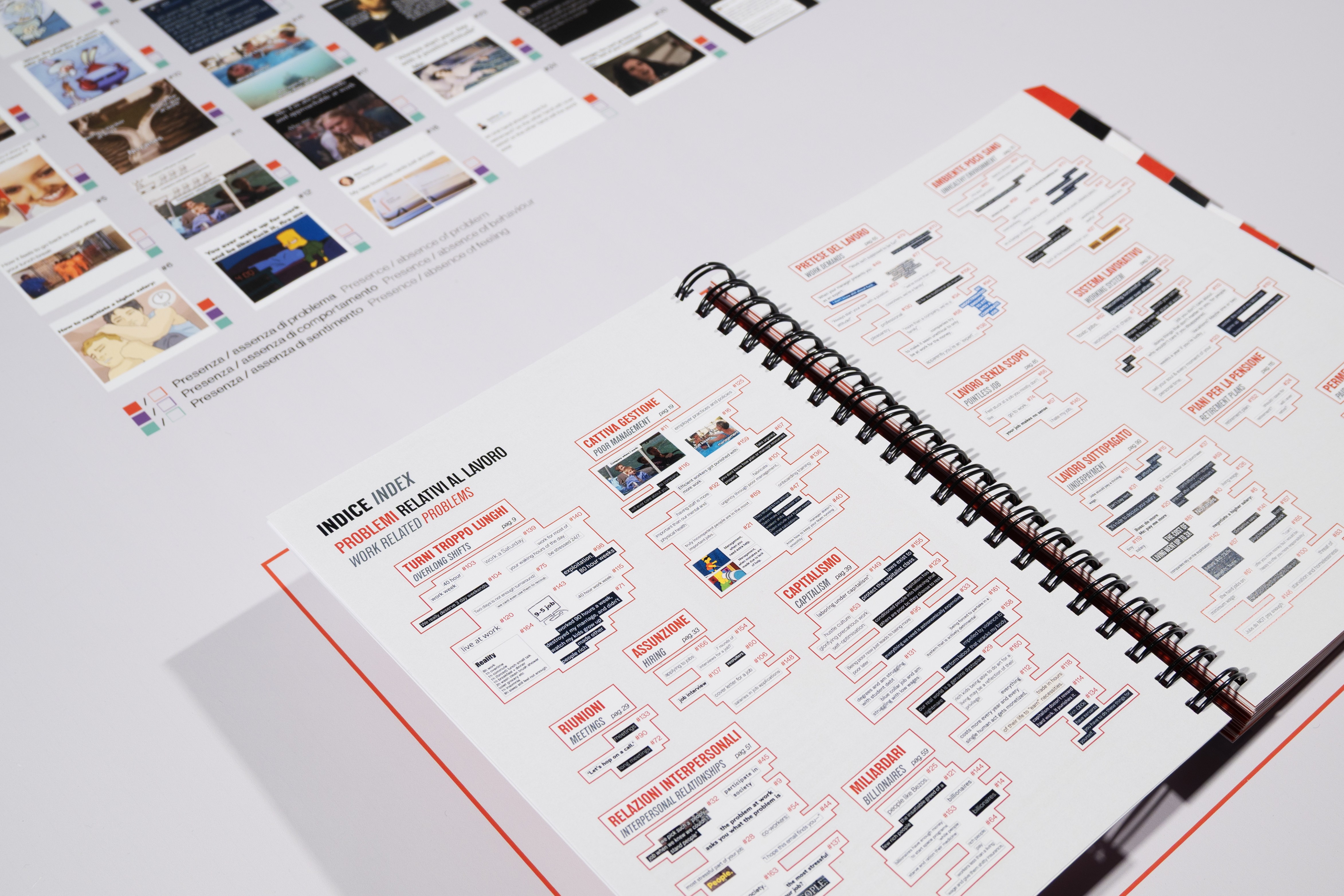
Exhibition detail: the grid displayed alongside one of the three catalogs.
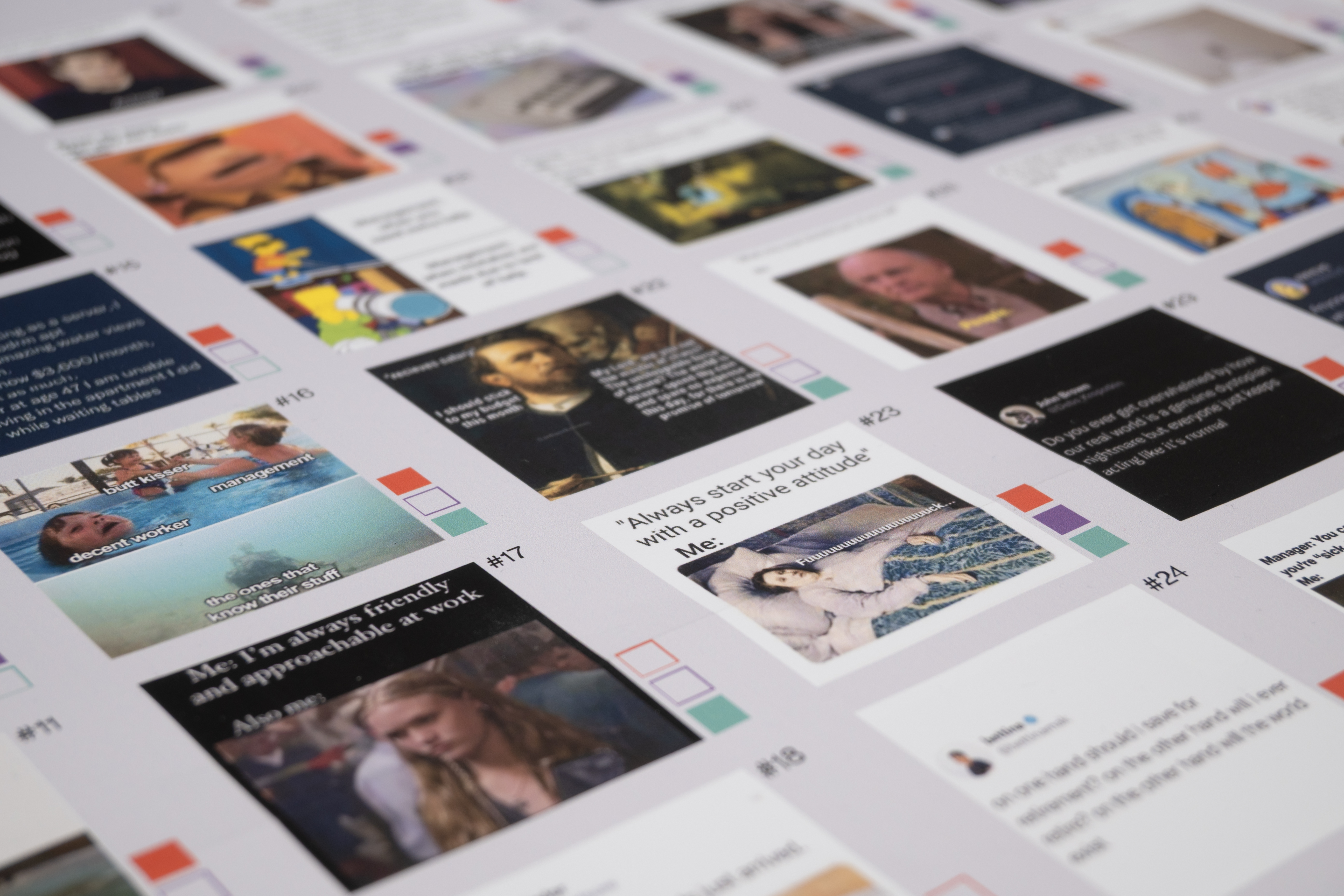
Close-up detail of the exhibition grid showing the ordering of the memes by engagement and the color-coded markers of the three interpretative dimensions.
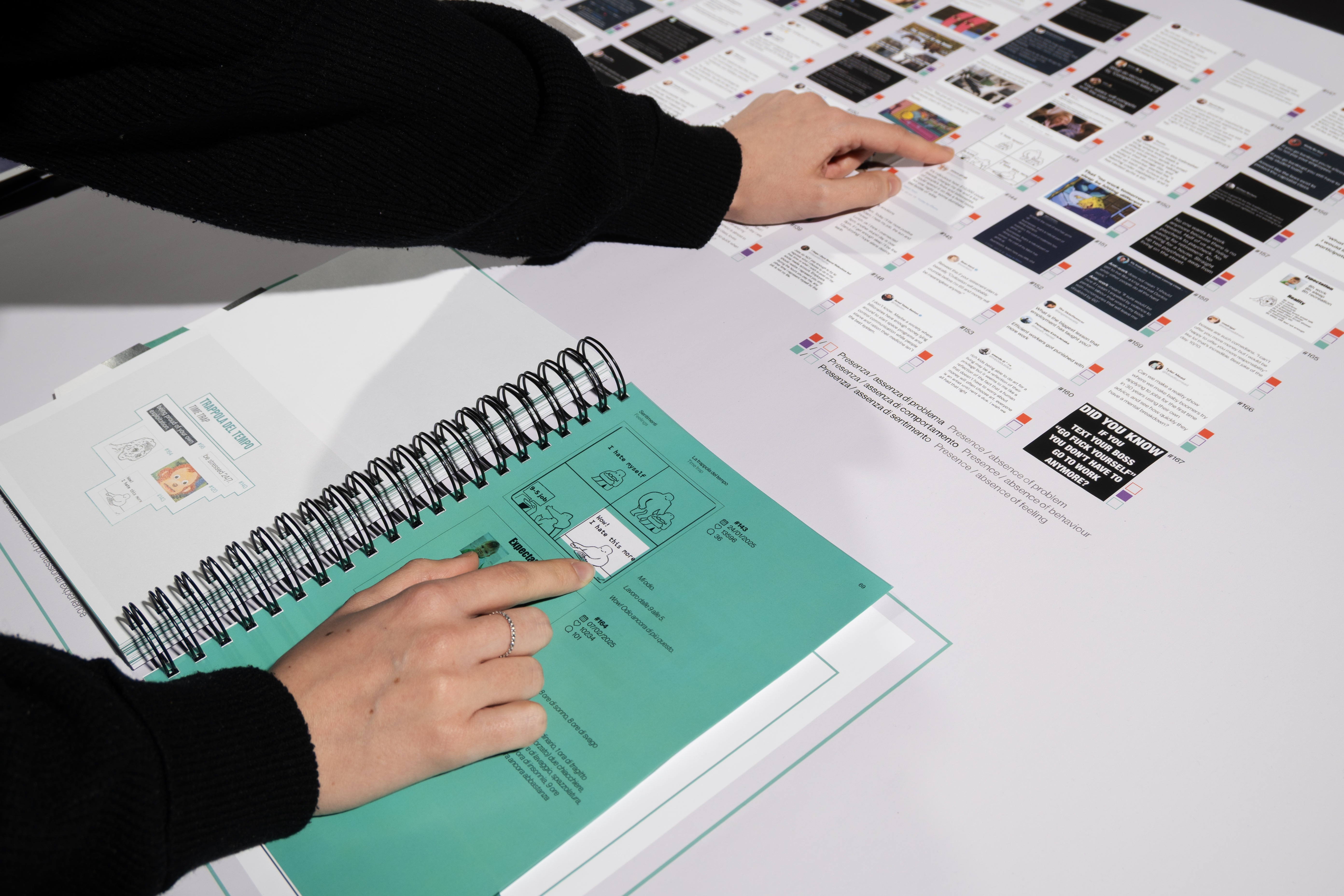
The memes displayed on the grid can be found within the catalogs, thanks to the color-coded markers and the numerical index.
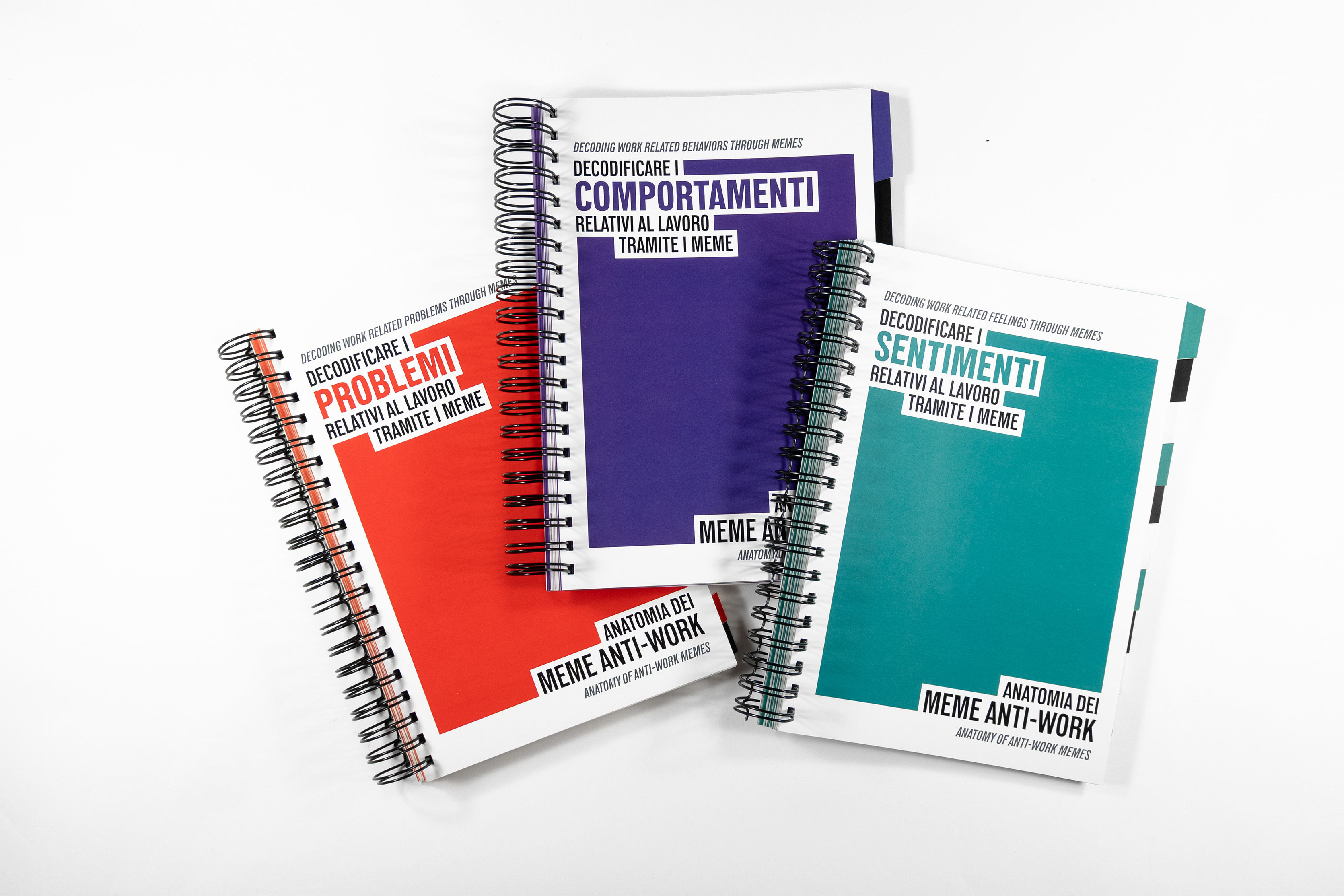
The three catalogs of the project, each dedicated to a specific interpretative dimension.
Each catalog, which serves as an in-depth exploration of the dimension to which it is dedicated, is introduced by a map that shows all the categories it contains. For each category, excerpts from the memes representing the problems, behaviors, or sentiments are presented, thus providing a comprehensive overview.
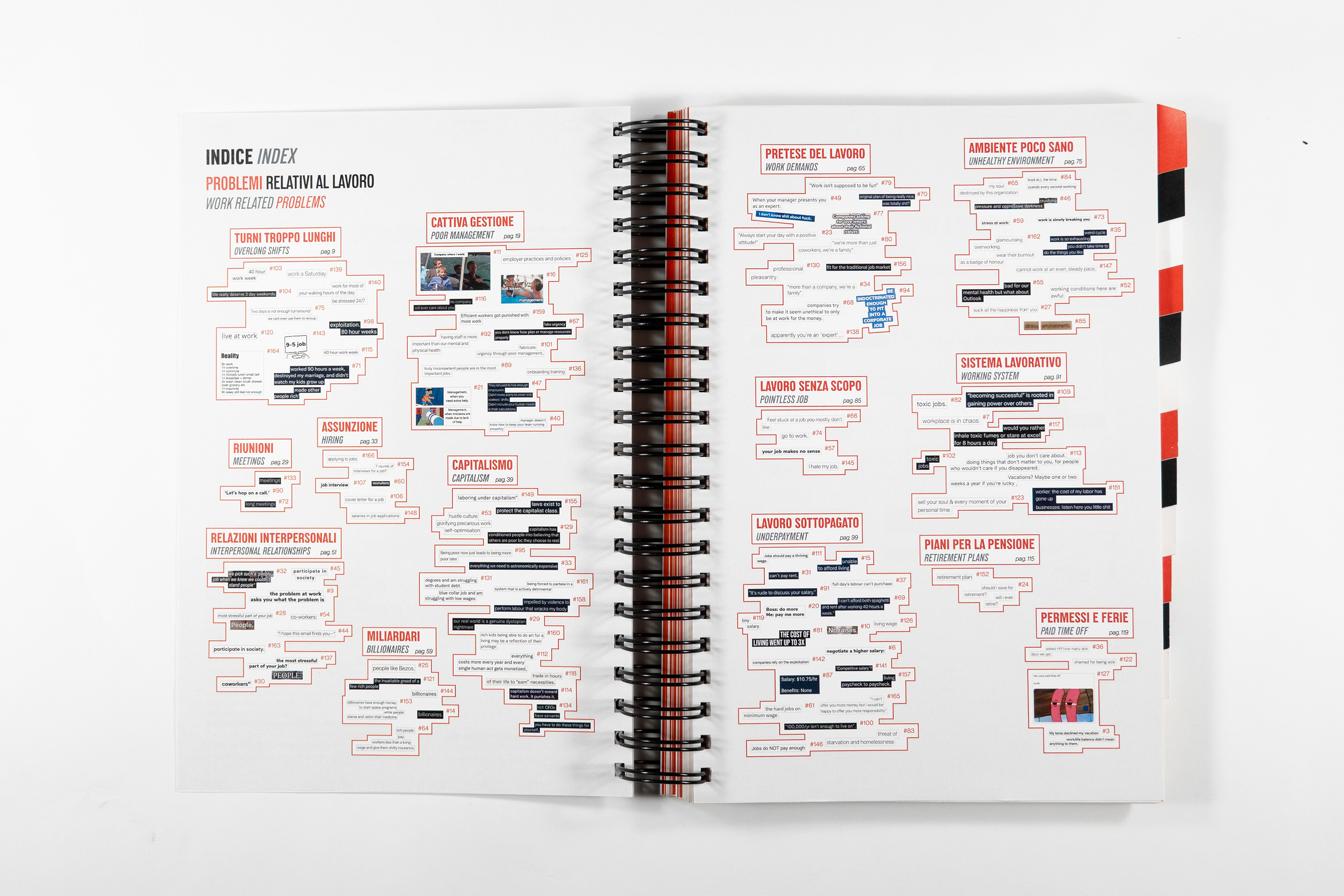
Introductory map of the problems catalog, showing the visualization of all thematic categories and the corresponding meme excerpts.
Each chapter of the catalog corresponds to a grouping and contains all the memes belonging to the category, ordered according to their level of engagement. The pages within the chapters are interspersed with colored acetate sheets, which isolate the relevant portions of the memes, facilitating their observation and analytical reading.
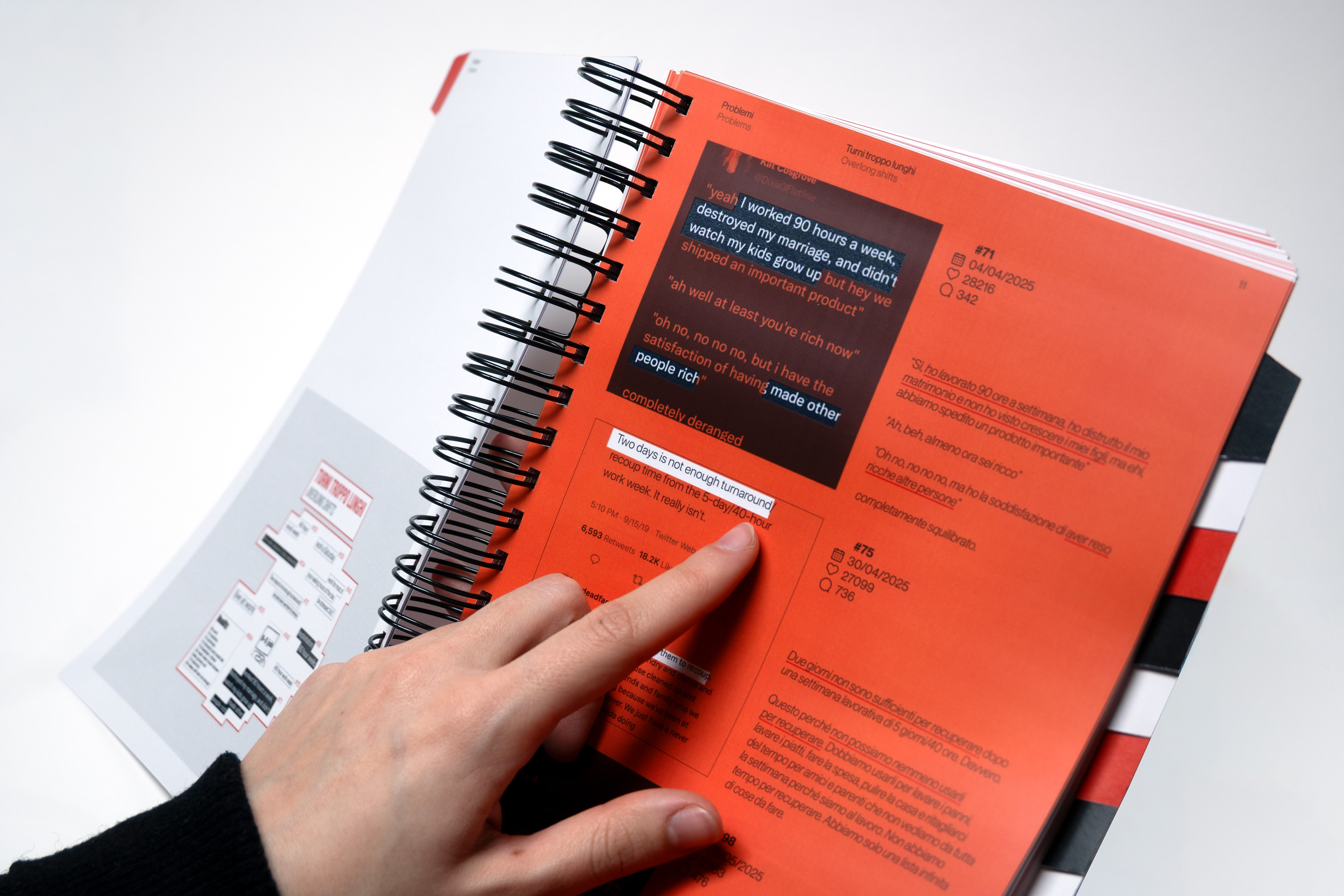
Detail of an internal catalog page with a colored acetate sheet highlighting the visual and textual portions of the meme.
The white pages within the chapters present the memes in their entirety, accompanied by the relevant metadata and the Italian translation of the texts, in which the portion of the meme corresponding to the acetate cutout is highlighted.
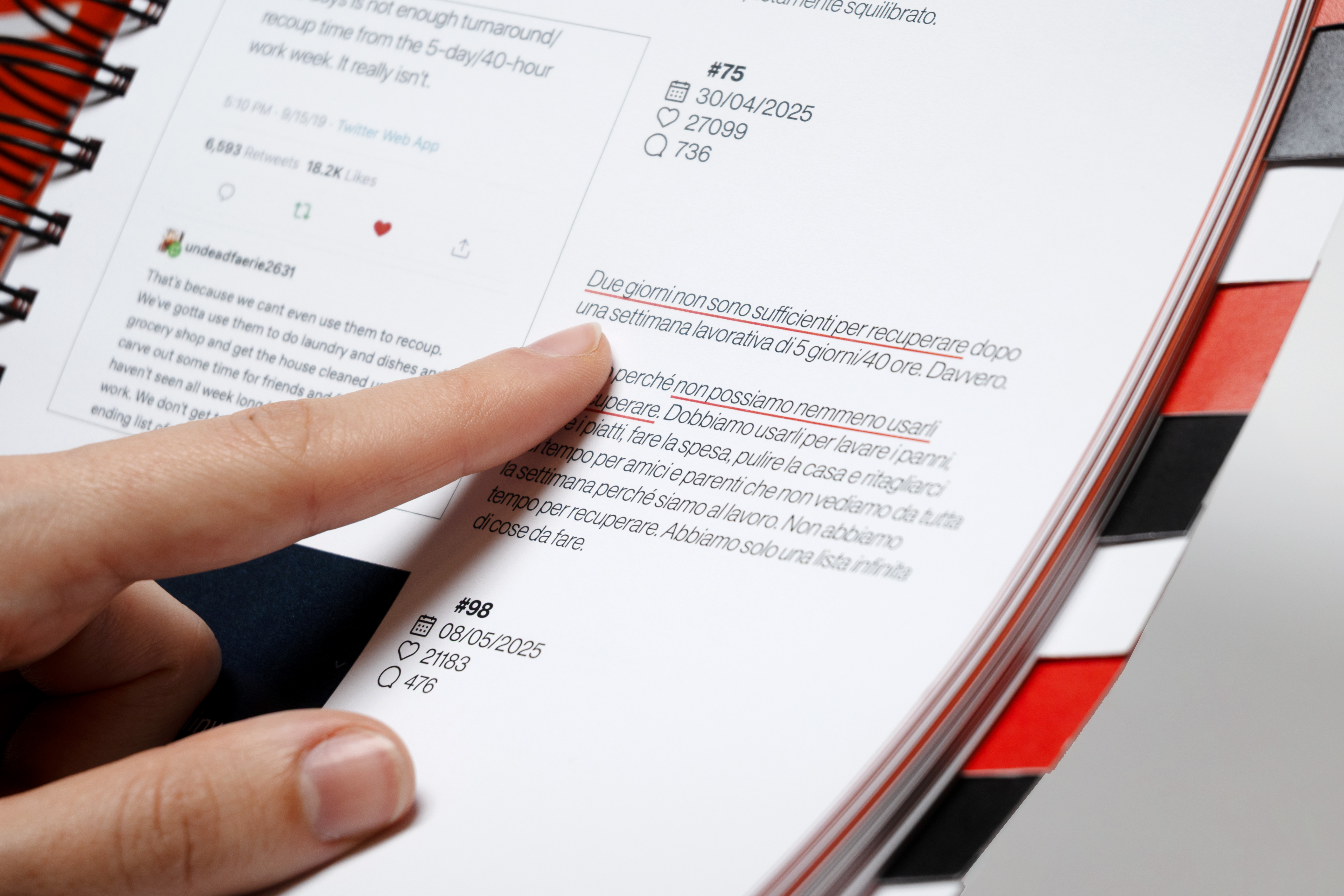
Detail of an internal catalog page.
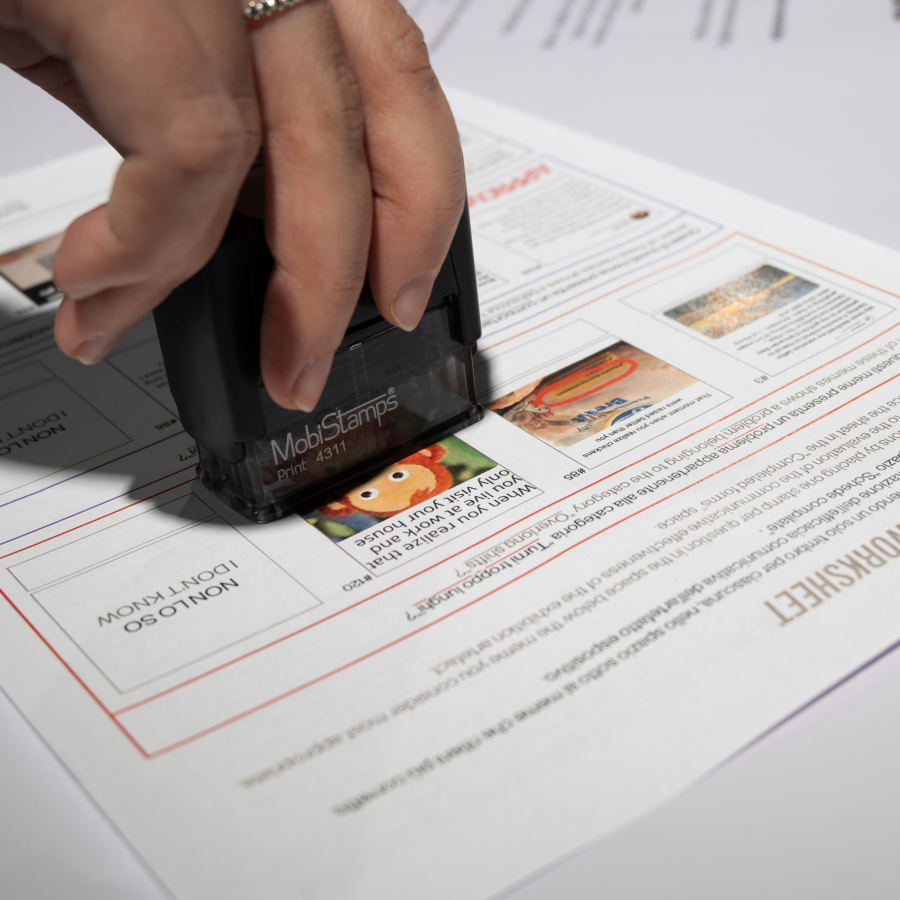
In the final phase of the experience, visitors are invited to independently identify the categories of problems, behaviors, and sentiments present in the memes. Through a questionnaire, the user places a stamp on the meme they consider representative of a given category indicated in the question.
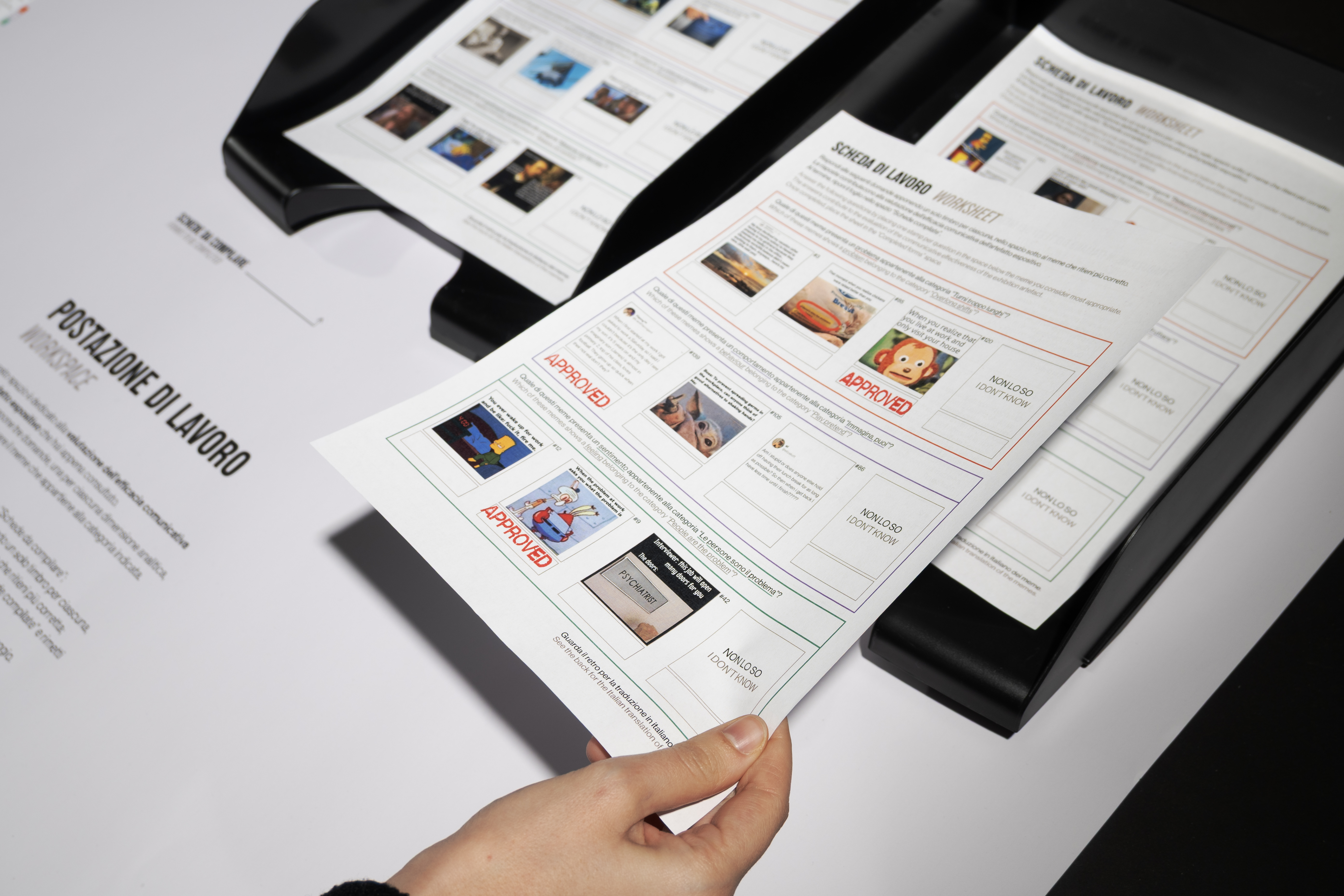
User interaction with the evaluation phase through the questionnaire and the stamps.
The effectiveness of the exhibition artifacts is evaluated based on visitors’ ability to correctly recognize the categories, transforming observation into an active moment of critical interpretation.
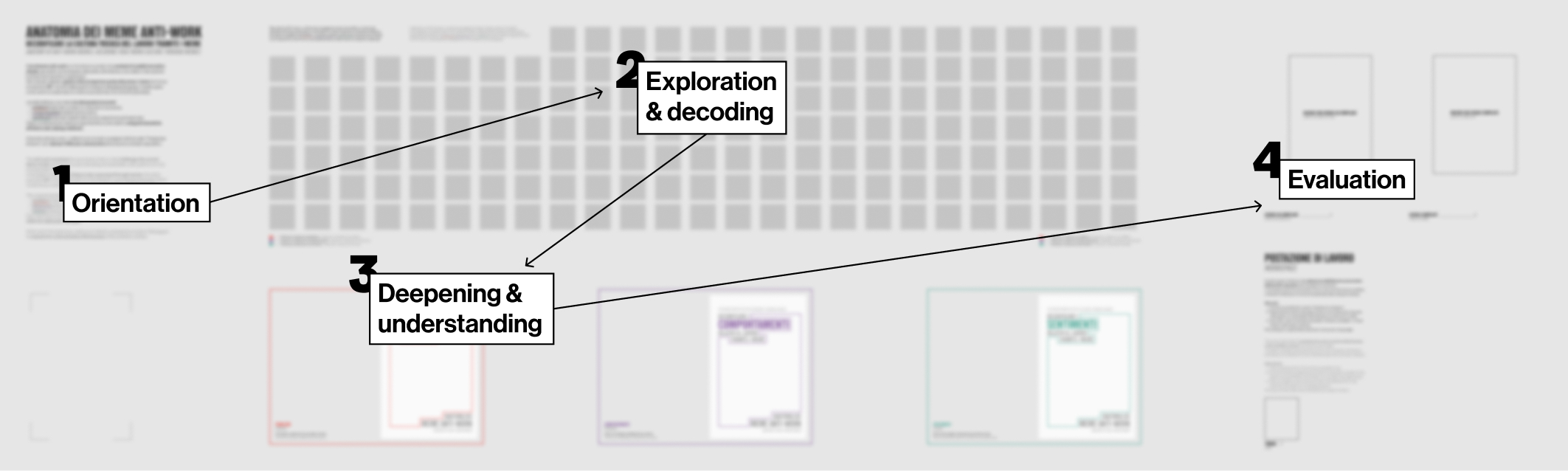
User flow illustrating the entire visitor experience with the designed exhibition artifacts.


