
A collection of user comments from YouTube and Reddit on Mukbang, organized according to food-related experiences

Eating with eyes
Mukbang is a digital phenomenon that originated in South Korea in the late 2000s, where a streamer consumes large amounts of food in front of the camera while interacting with the audience. Initially a form of virtual companionship during meals, mukbang has evolved into shorter, more visually intense videos that combine entertainment, food aesthetics, ASMR, and performance. The result is a visual language capable of evoking a wide range of emotions: from pleasure to curiosity, from hunger to repulsion.
This installation project explores how behind the visual spectacle of Mukbang’s excessive eating lies a complex social space in which users seek connection, emotional support, and ways to navigate their everyday routines and challenges with food. To map the emotional and behavioural patterns of the community, the project organises 107 comments from YouTube and Reddit into four main categories, distinguished by different colours and further divided into sub-categories.
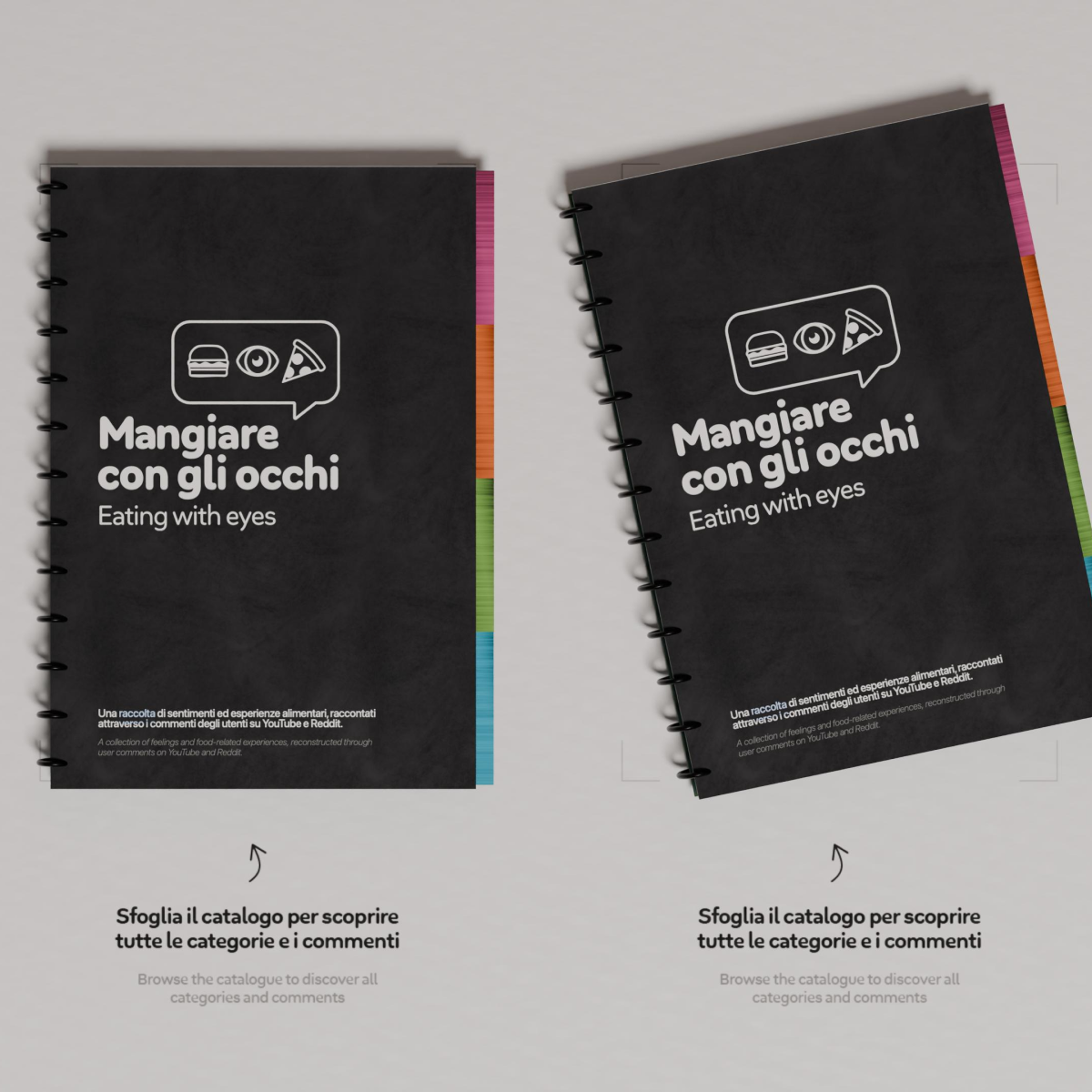
It consists of a printed catalogue and a complementary video that translates user comments on mukbang videos into a structured narrative about food, emotions, and digital intimacy. Alongside the catalogues and the video, an interactive section allows visitors to match comments to categories, directly experiencing the process of classification.
Data Design
The project is based on a qualitative and fully manual transformation of user comments, treating them as personal, situated statements rather than abstract data points. No automated tools, such as sentiment analysis or keyword extraction, were used in the selection phase.
Following data collection, comments were selected through close reading, focusing exclusively on explicit declarations where the user's feeling was unequivocally stated. Comments that were ambiguous or required personal interpretation were discarded.
Inclusion logic: The comment “So satisfying keep up the good work 👍” was selected because it provides an unambiguous record of satisfaction, a key sub-category under Feelings and Sensations. In parallel, the selection aimed to document eating habits. A representative example is: “Whenever I feel hungry I just watch people eat food and I’m not hungry anymore. Phantom food”. This was included because it details a specific functional behavior— using visual stimuli to suppress physical hunger—serving as primary evidence for the Appetite Management category.
Exclusion logic: Conversely, comments like “watching this after 2 hours of cardio and enjoying my meal, perfect timing :D” were discarded. In cases like this, the ironic tone obscures the true motivation or emotional state of the user, making it unsuitable for the dataset.
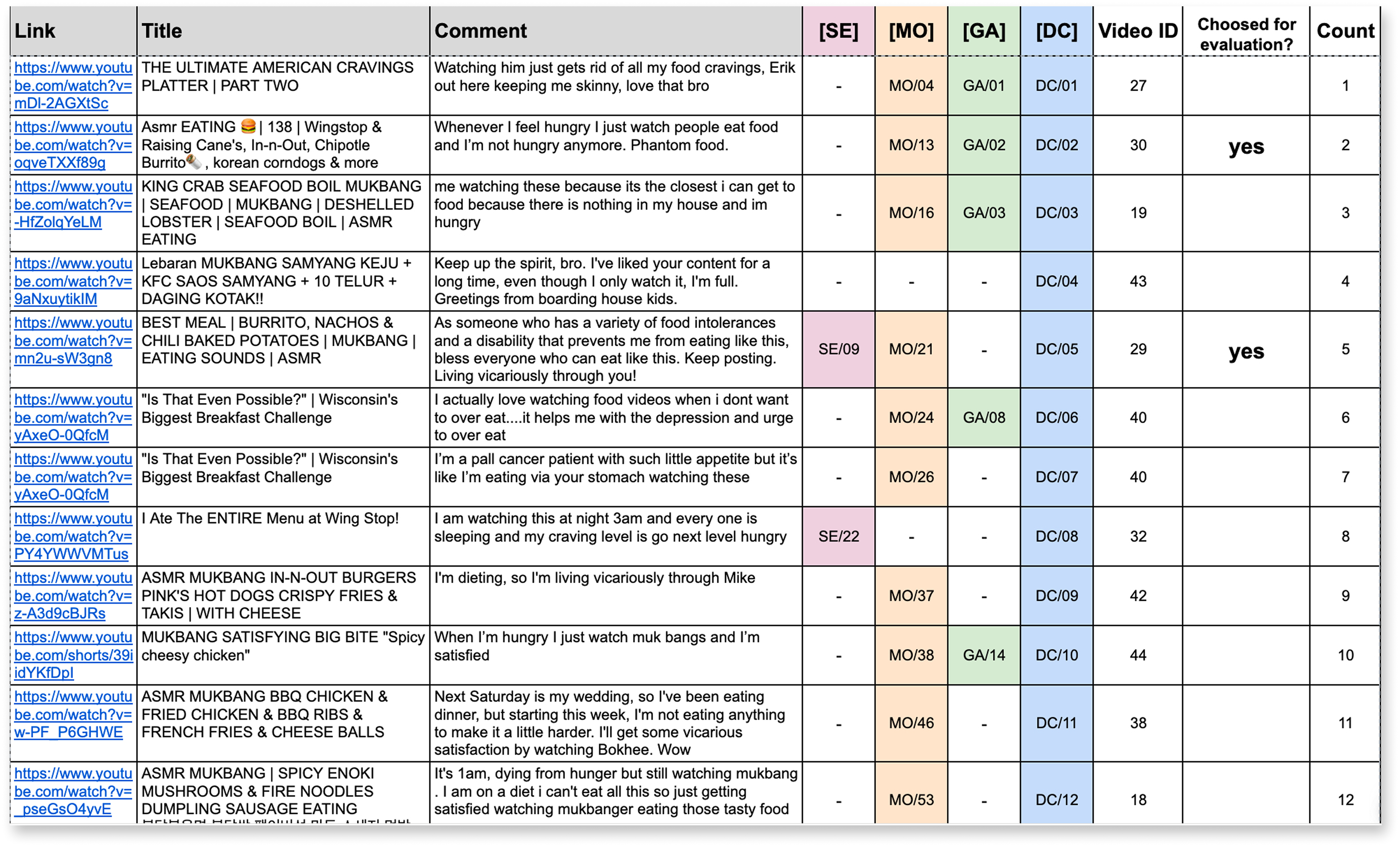
A snapshot of the collected comments from YouTube and Reddit used for the qualitative analysis.
The first step in data processing involved thematic sorting, in which each comment was assigned to one or more of the four resulting categories:
- Feelings and sensations: spontaneous physical reactions, such as food cravings or satisfaction, generated by watching mukbang videos (e.g. “You make me hungry 🤤”).
- Motivations: Explicitly stated reasons for watching, focusing on intentional behavioral patterns rather than implied interests (e.g. “Who came just because of Ramadan and because they hungry”).
- Appetite management: The functional use of videos as a tool to regulate hunger or assist in daily eating routines (e.g. “as someone with a very bad eating disorder, zach really helped me find food more appetising”).
- Disembodiment: Experiences of bodily detachment, where watching another person eat provides a vicarious sense of fullness and satisfaction (e.g. “When I’m hungry I just watch mukbangs and I’m satisfied”).
Overlaps between categories were preserved to reflect the complexity of users’ experiences, rather than forcing comments into a single interpretative frame.

Each of the four categories is identified by a specific color, acting as a visual guide across the video interface, the physical installation, and the catalogue.
Comments are organised into the main four categories, which are further articulated into more specific sub-categories to increase the precision of the classification. For instance, Motivations are broken down (among others) into religious fasting, dietary restrictions, companionship, and hunger, while Feelings and sensations include guilt, disapproval, joy, relaxation, and satisfaction.
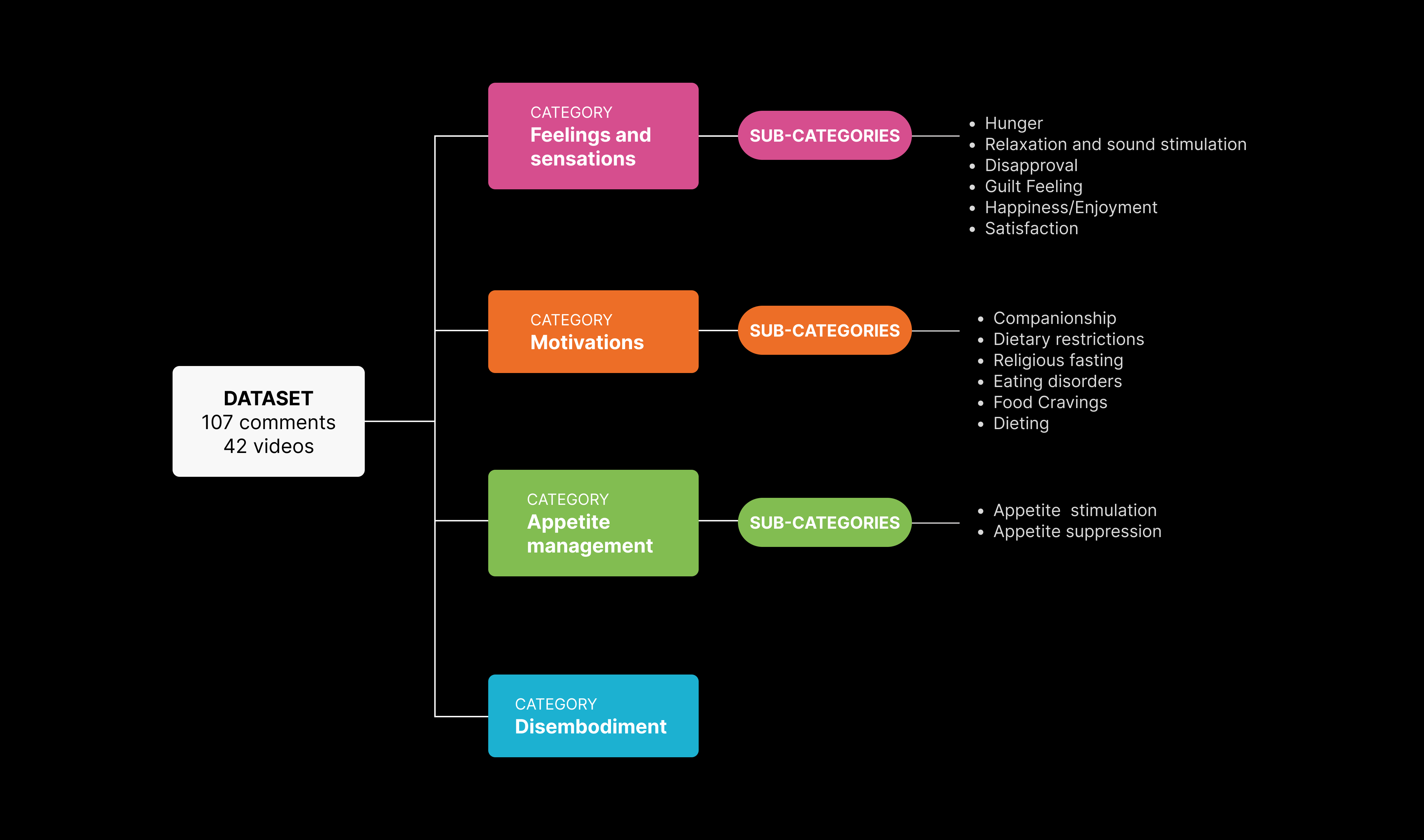
Hierarchical taxonomy of the dataset.
Artifact Design
In the printed catalogue, comments are presented as editorial fragments while remaining connected to their original video context. Each comment is accompanied by information about the source video, including its thumbnail, allowing readers to situate the statement within the visual content that generated it.
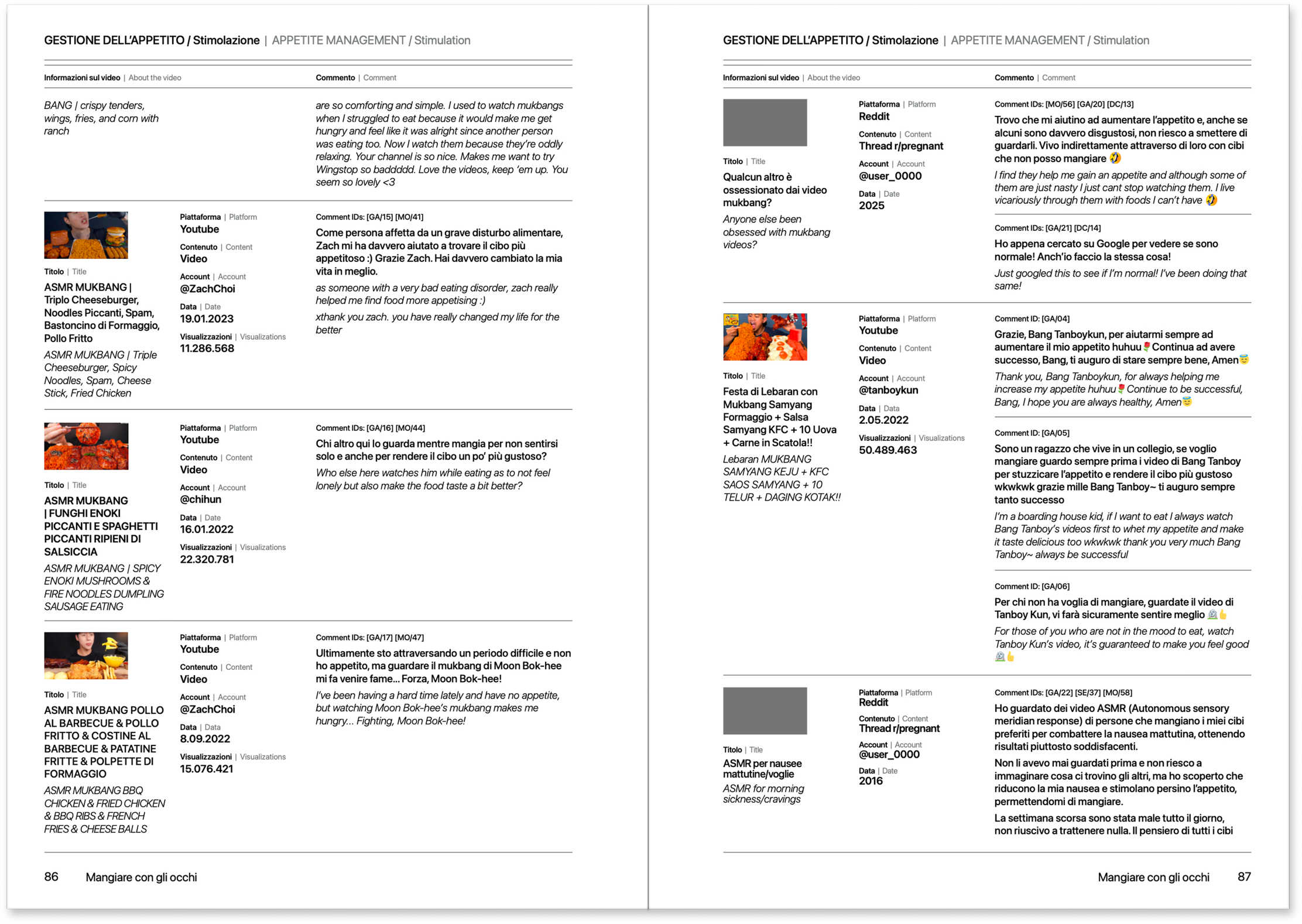
Comments are paired with their original video thumbnails; grey rectangles indicate text-only threads from Reddit.
This structure allows readers to trace recurring emotional and behavioural patterns while navigating the dataset beyond platform-driven hierarchies of popularity or engagement.
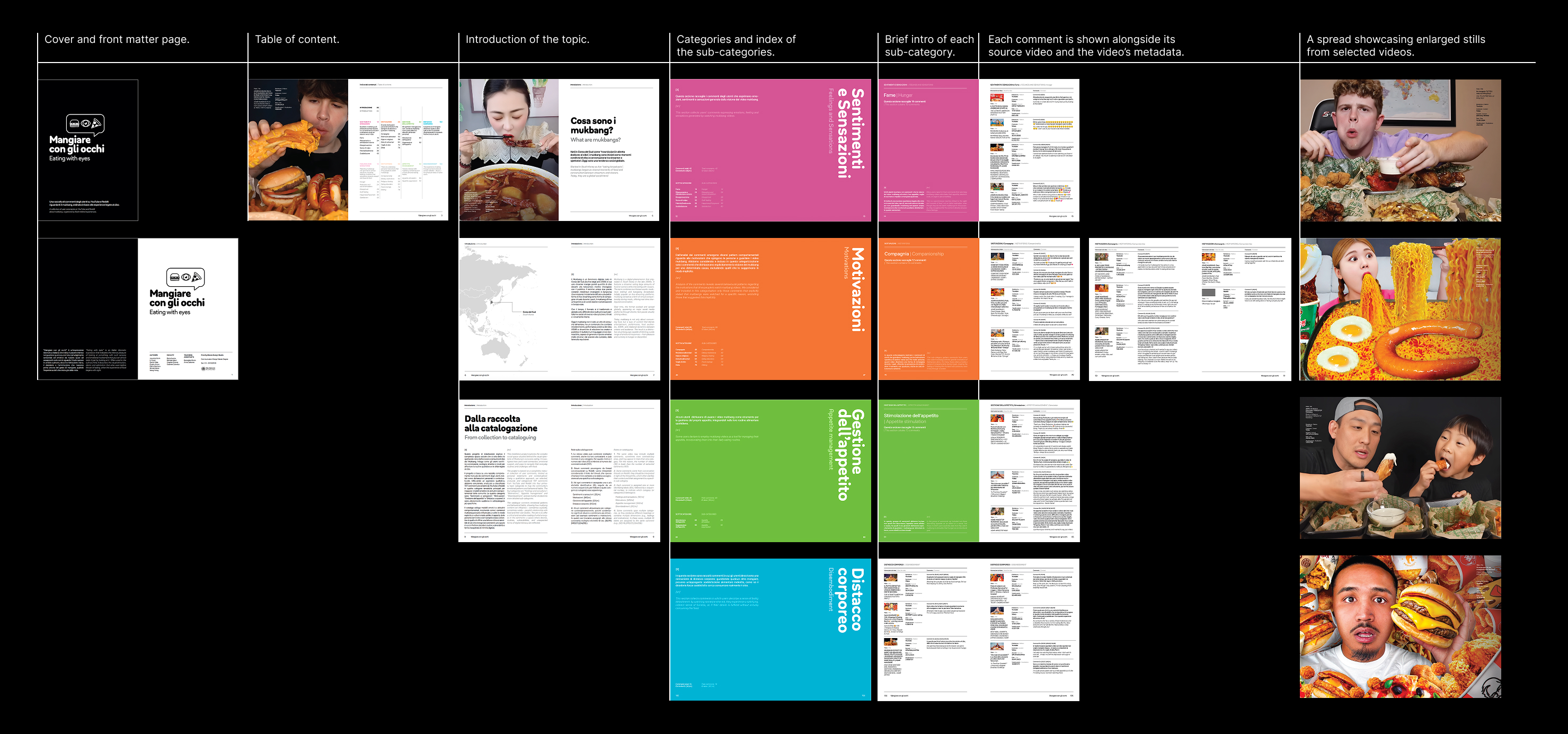
The logical structure of the catalogue, categories and sub-categories.
A Video Installation of 3’10’’ video reconnects user comments to their original sources, processing a dataset of 107 comments and 42 videos. Structured around the four color-coded categories, the work foregrounds sound to emphasize the ASMR triggers that shape user responses. Visually, the design employs a grid of repeated frames, illustrating the multiplicity and repetitive nature of the mukbang experience.
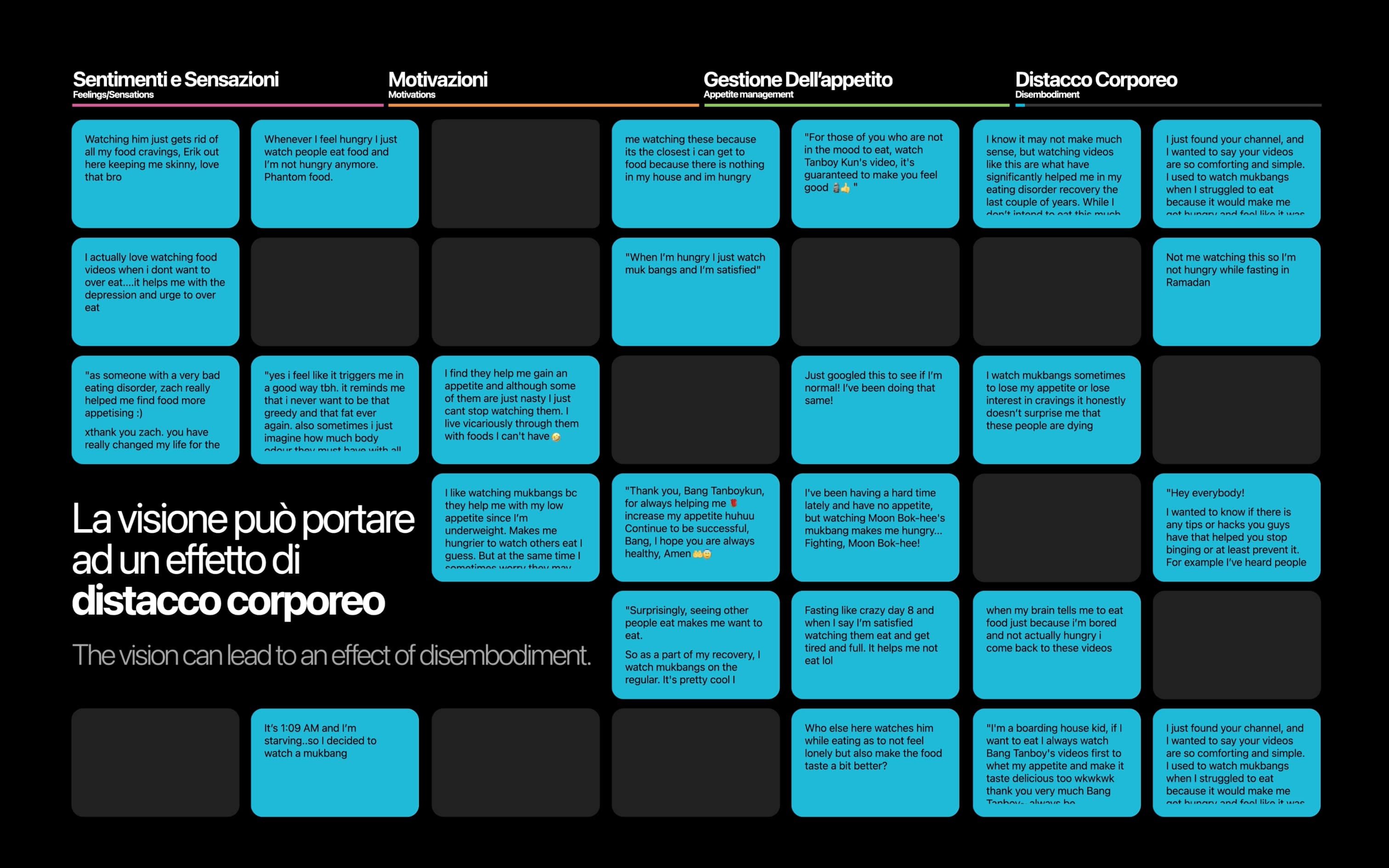
This layout utilizes a grid format to visualize the vast volume and multiplicity of collective discourse within the dataset.
The visual flow alternates between “thematic grids” – screens filled with colour-coded comments – and “blow-ups”. These blow-ups begin by associating the individual comment with the original film clip, to highlight its context of origin, before moving to full screen, allowing for total sensory immersion.
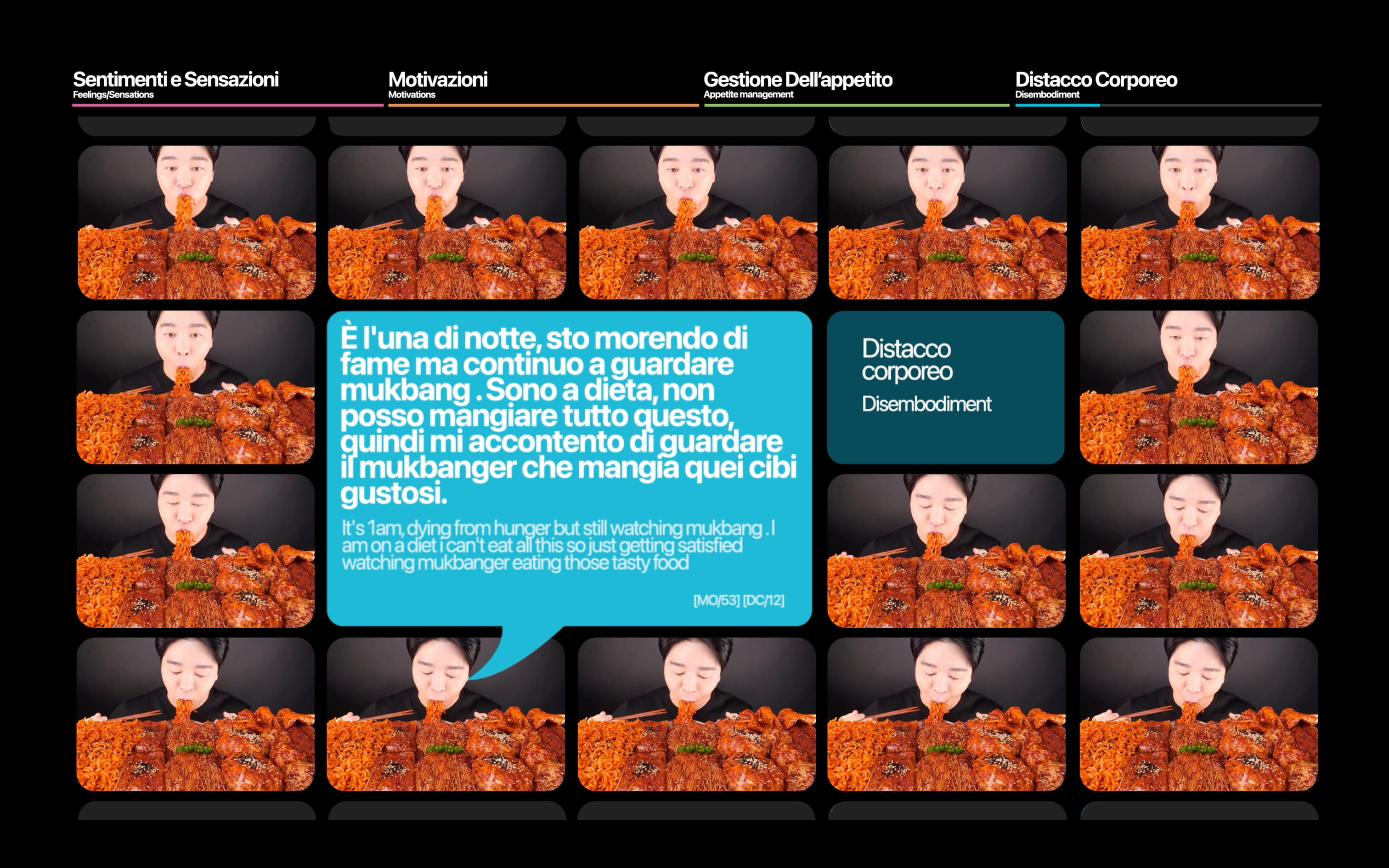
This sequence isolates individual comments alongside their source footage to foreground the direct link between sensory stimuli and user response.
As shown in the timeline diagram below, the four sequences end with a series of full-screen frames, and the video concludes with a countdown, reinforcing the looped structure of the installation.
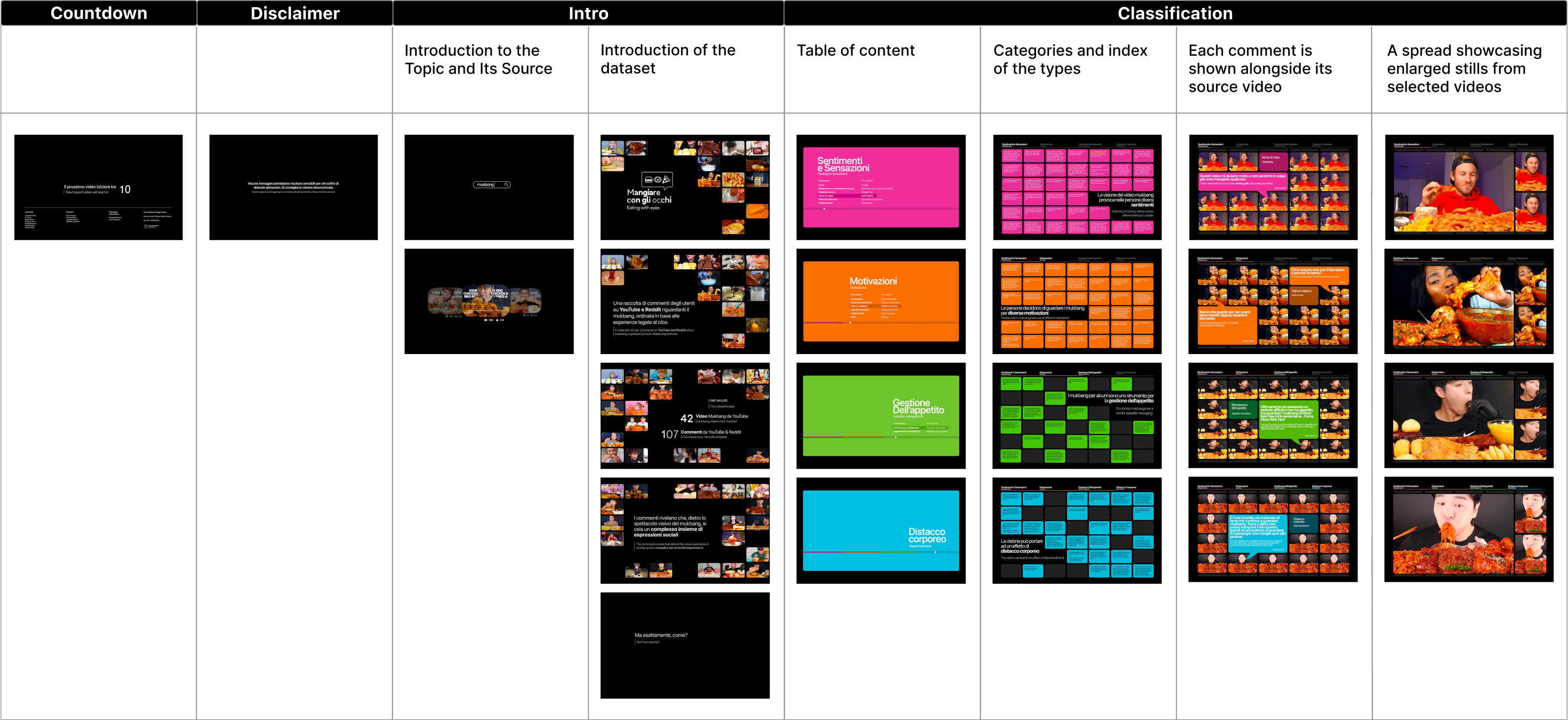
Diagram of the different sections of the video.
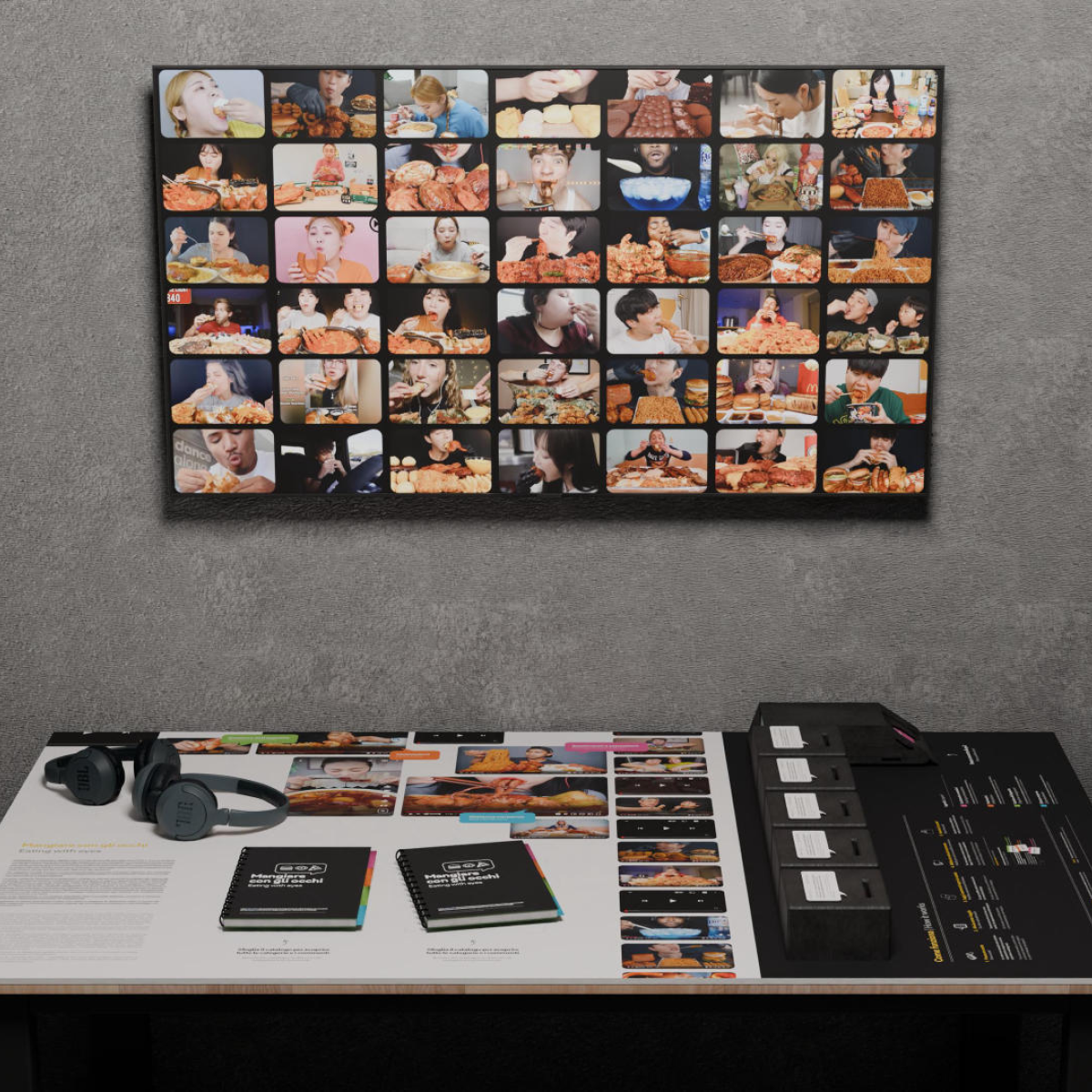
The spatial configuration completes the transformation process. In front of the screen, a table displays two copies of the catalogue, while on the right-hand side, an interactive section allows visitors to participate in the cataloguing process by actively matching comments to categories and sub-categories.
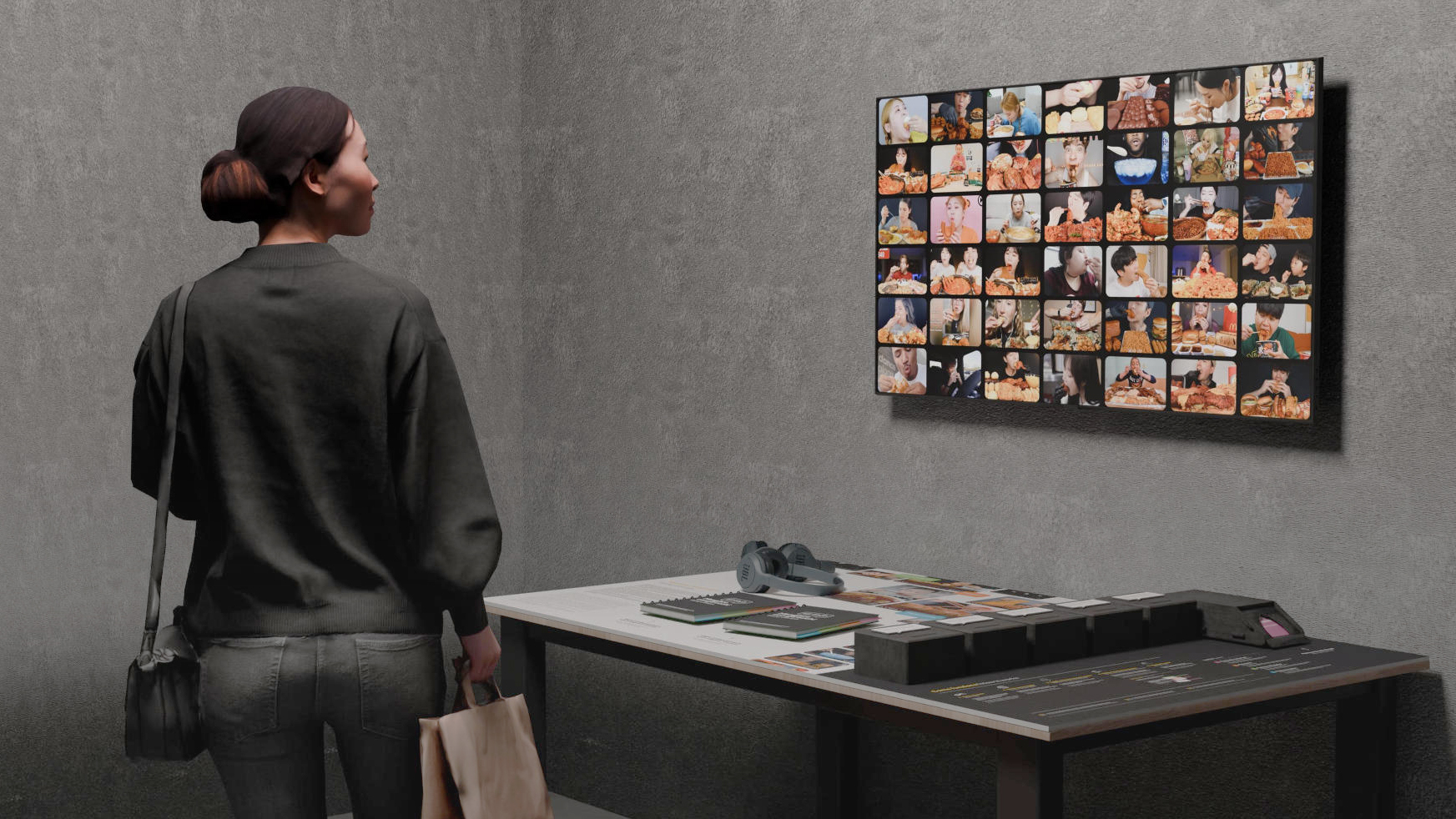
The complete exhibition support.
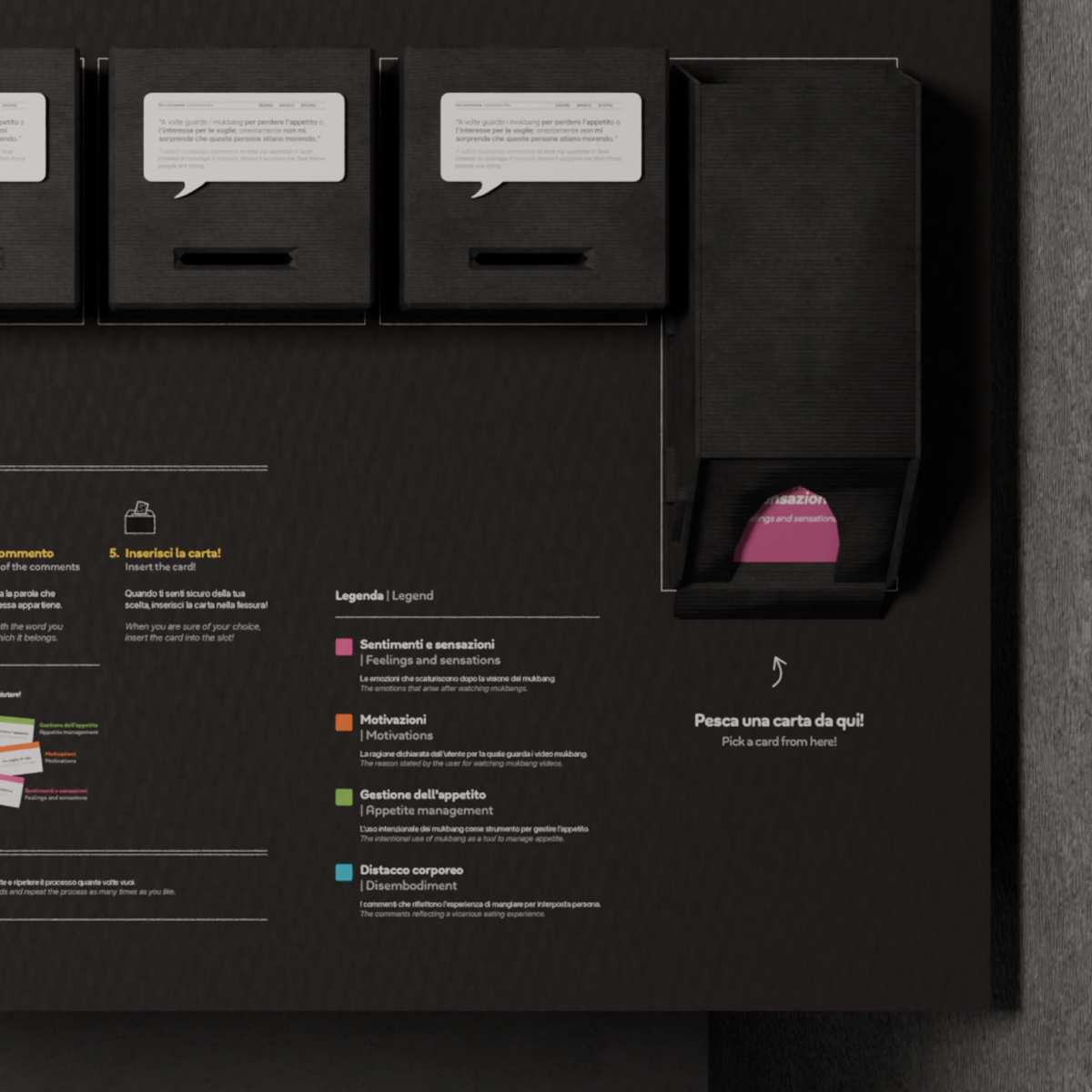
Guided by a legend and instructions, visitors participate in a practical classification exercise: they will draw a card, which identifies a category and a sub-category, and will have to match it to one of the five comments in the dataset, each placed on top of a box. Since the cards to be drawn show a random mix of all categories and sub-categories, and the boxes show five comments to which multiple cards can be matched, the task requires visitors to actively apply the classification logic of the project.
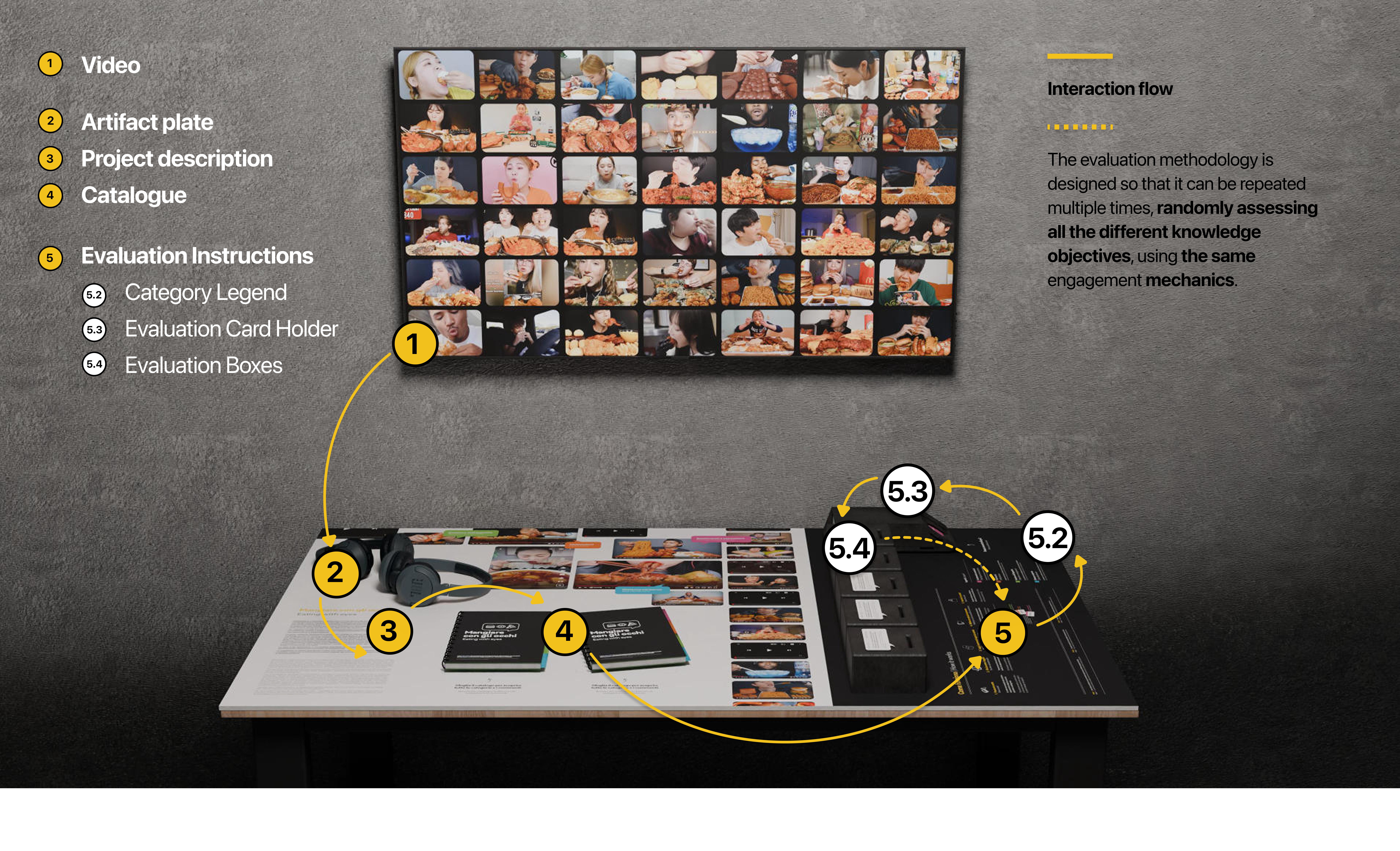
The user journey follows a linear sequence: sensory immersion (Video)→ reflective reading (Catalogue) → active classification (Interactive Station).
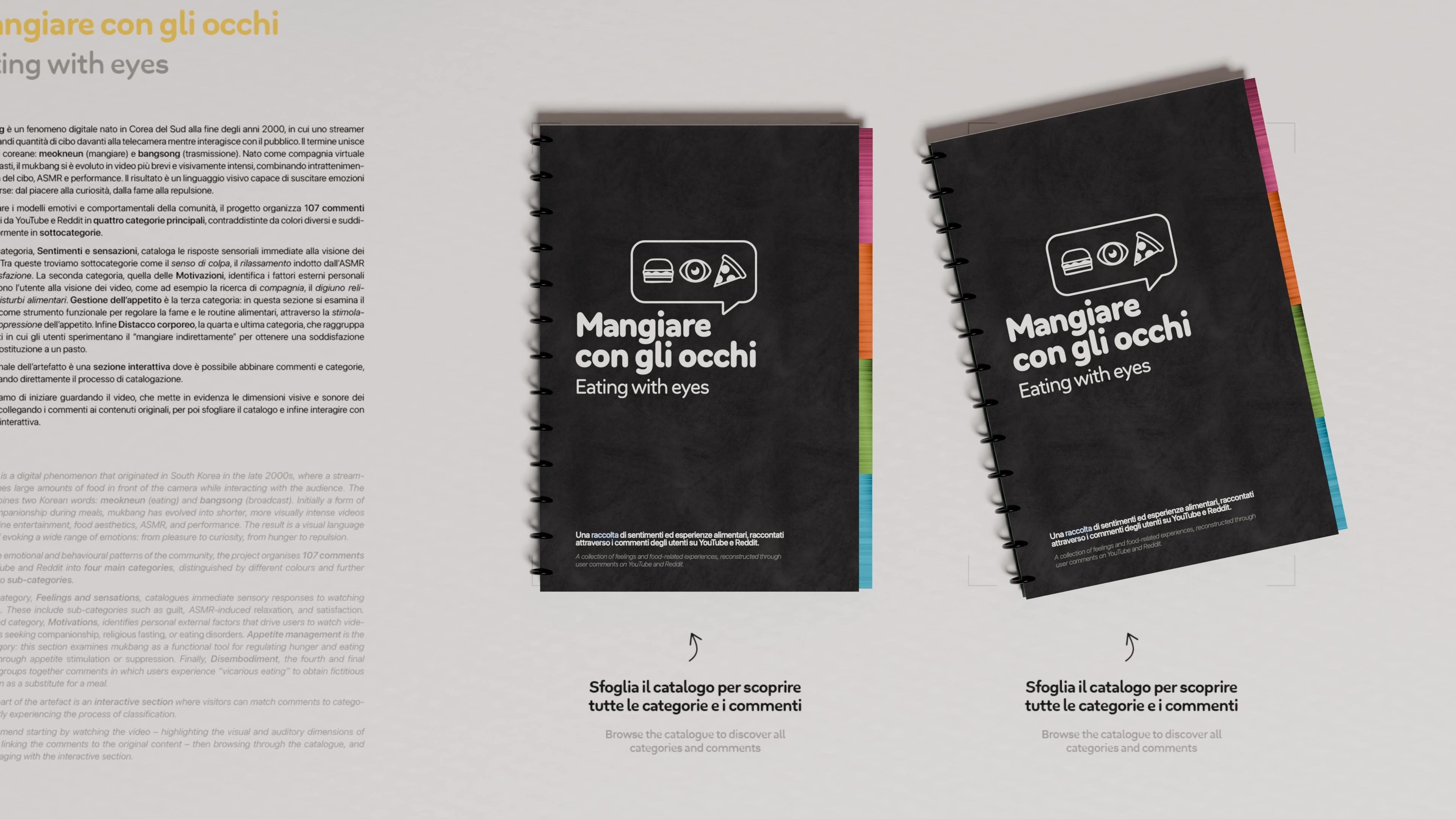
Visitors first engage with the printed catalogue, exploring the comments in a static, reflective format before interacting with the system.
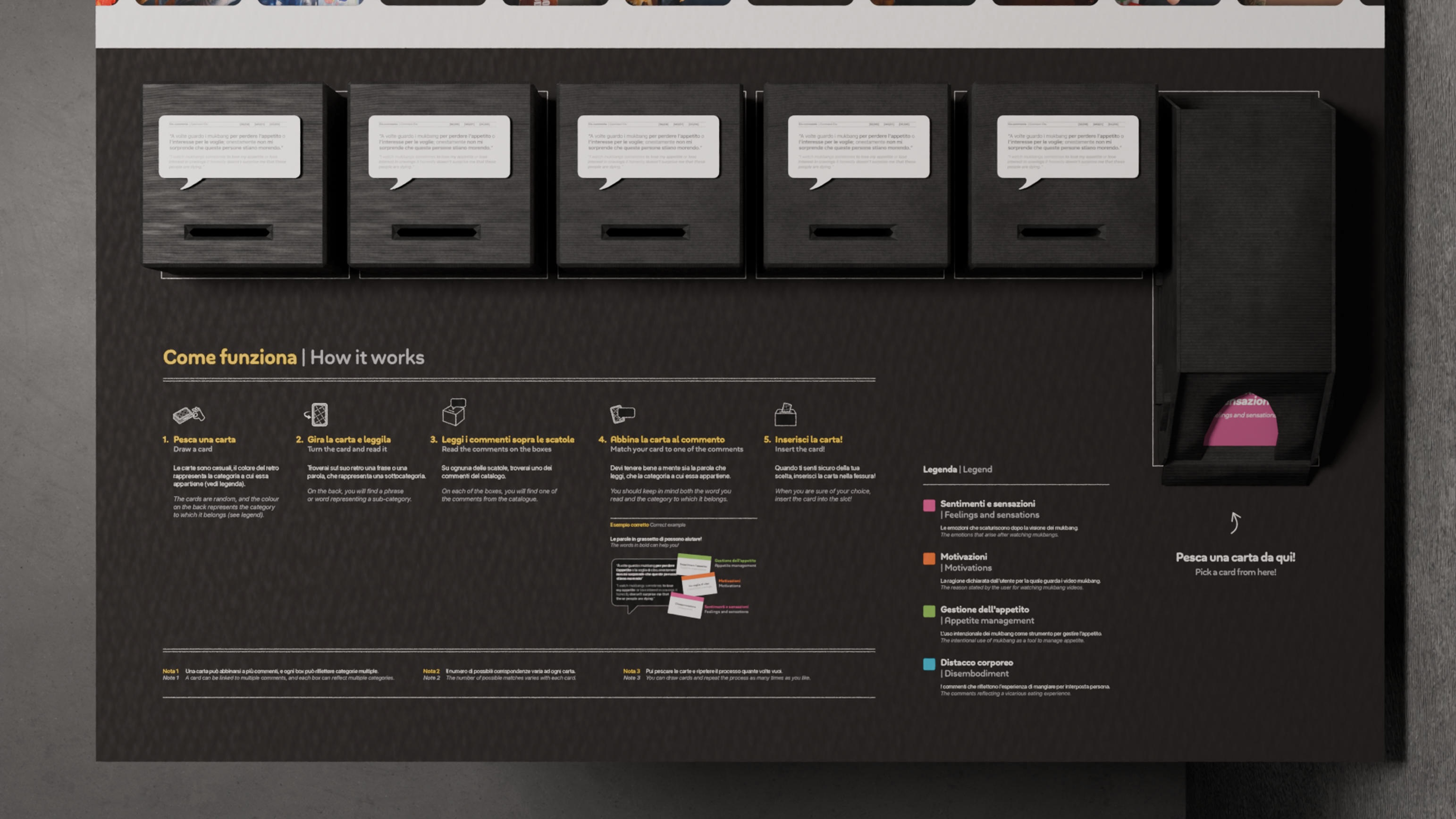
The interactive physical section.


