
The Rules for Women’s Happy Ending

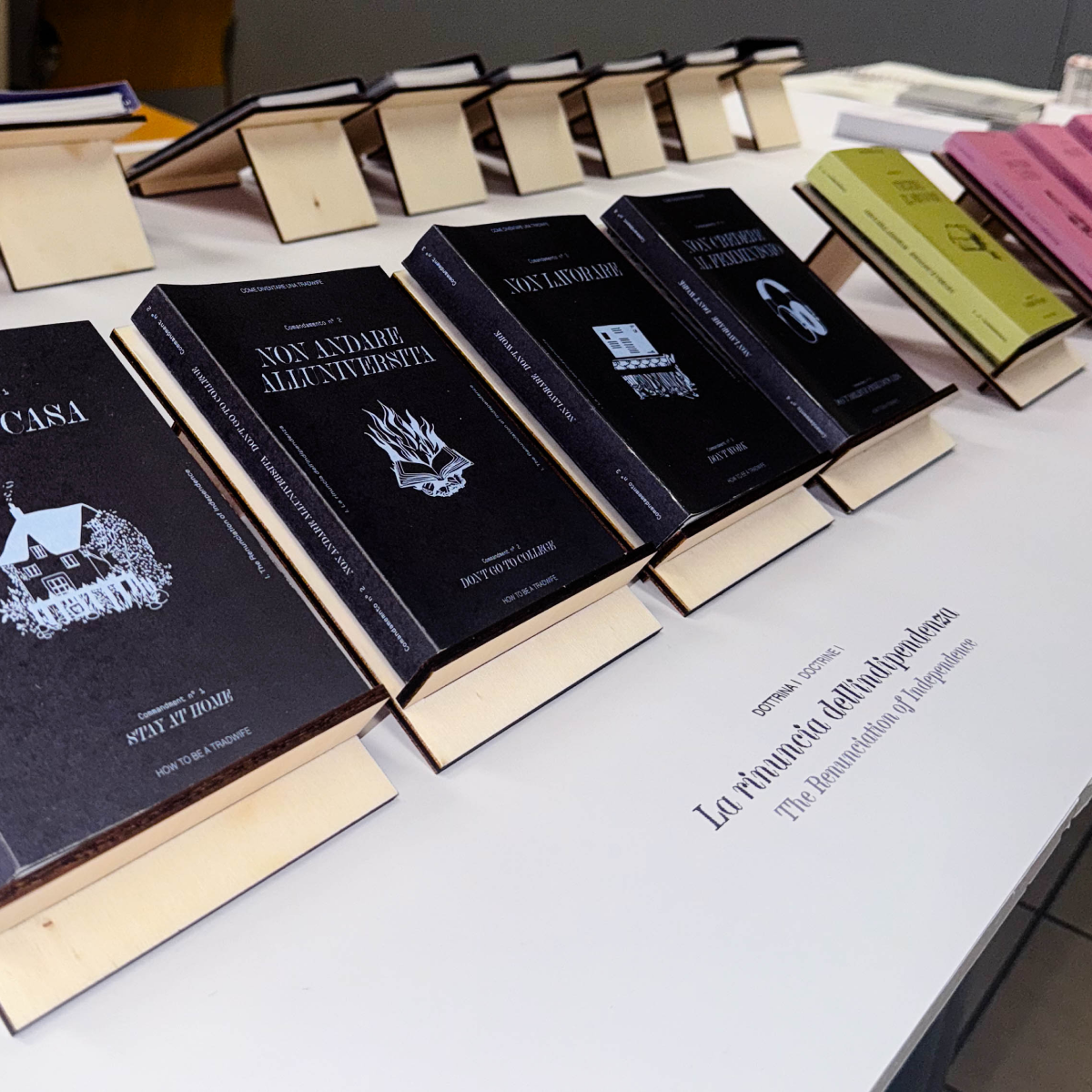
The project “Tradwives Commandments – Rules for Women’s Happy Ending” is an editorial artifact that examines the U.S. Tradwife trend on TikTok through the series “How to Become a Tradwife,” structured in two collections.
The “Commandments” collection organizes quotations from 174 TikTok videos published by 44 accounts into 18 books. Each book focuses on one commandment prescribing women’s behavior and life choices. These commandments are grouped into five broader categories, called “Doctrines,” visually identified by each book’s cover color.
The “Holy Cards” collection gathers images of husbands and children from 65 TikTok posts by 18 accounts, showing how marriage and motherhood are presented as the core of female identity.
Overall, the artifact reveals a normative system that promotes obedience through promises of happiness and implicit threats.
Artifact design
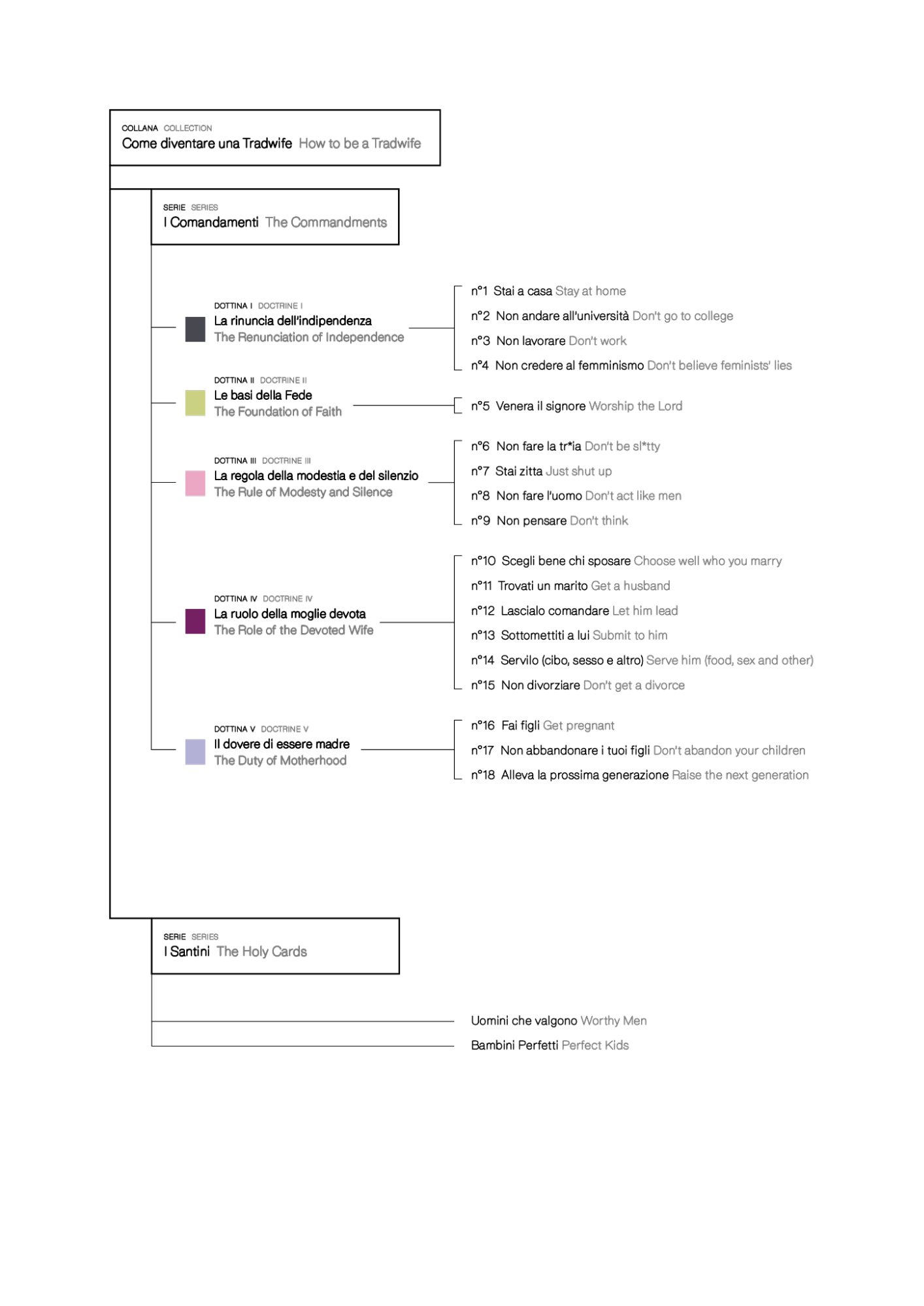
[Project structure]
The exhibition artifact was designed through a qualitative transformation of collected content. Starting from each video’s transcript, significant textual fragments were manually extracted to capture the core concepts in Tradwife discourse and to expose, more or less explicitly, the conservative ideology underpinning the trend.
Quotations were then compared and connected, linking different statements to a defined set of recurring normative claims. Referencing the religious imagery that characterizes the trend, these claims were rhetorically translated into “commandments”: metaphorical and dogmatic formulations that define what women should or should not do according to Tradwives.
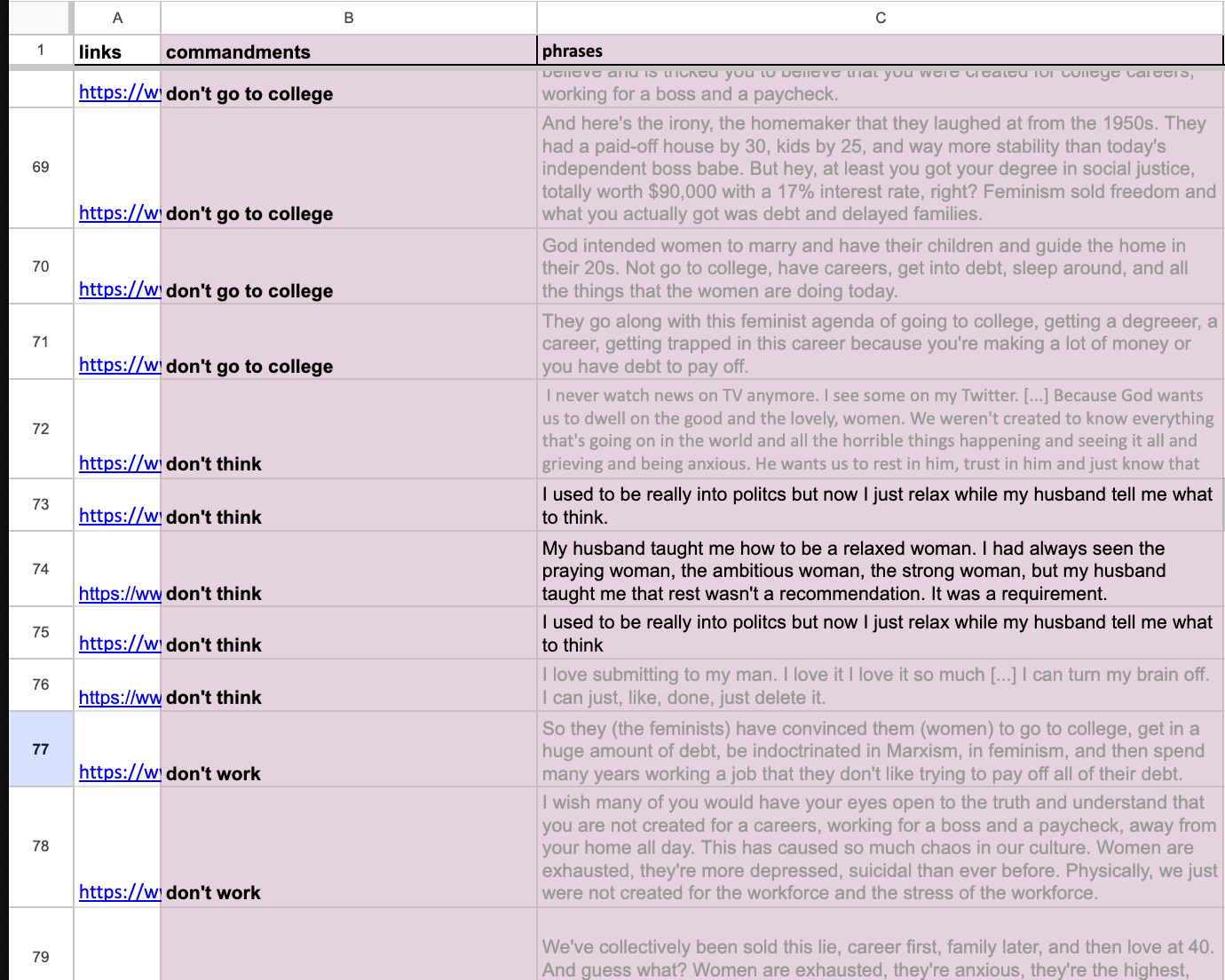
[Dataset screenshot: each quote mapped to a commandment]
Commandments were organized into five doctrines representing five macro-categories and chronologically ordered stages of women’s lives: from giving up individual independence, through faith, modesty, and silence, to marriage and motherhood.
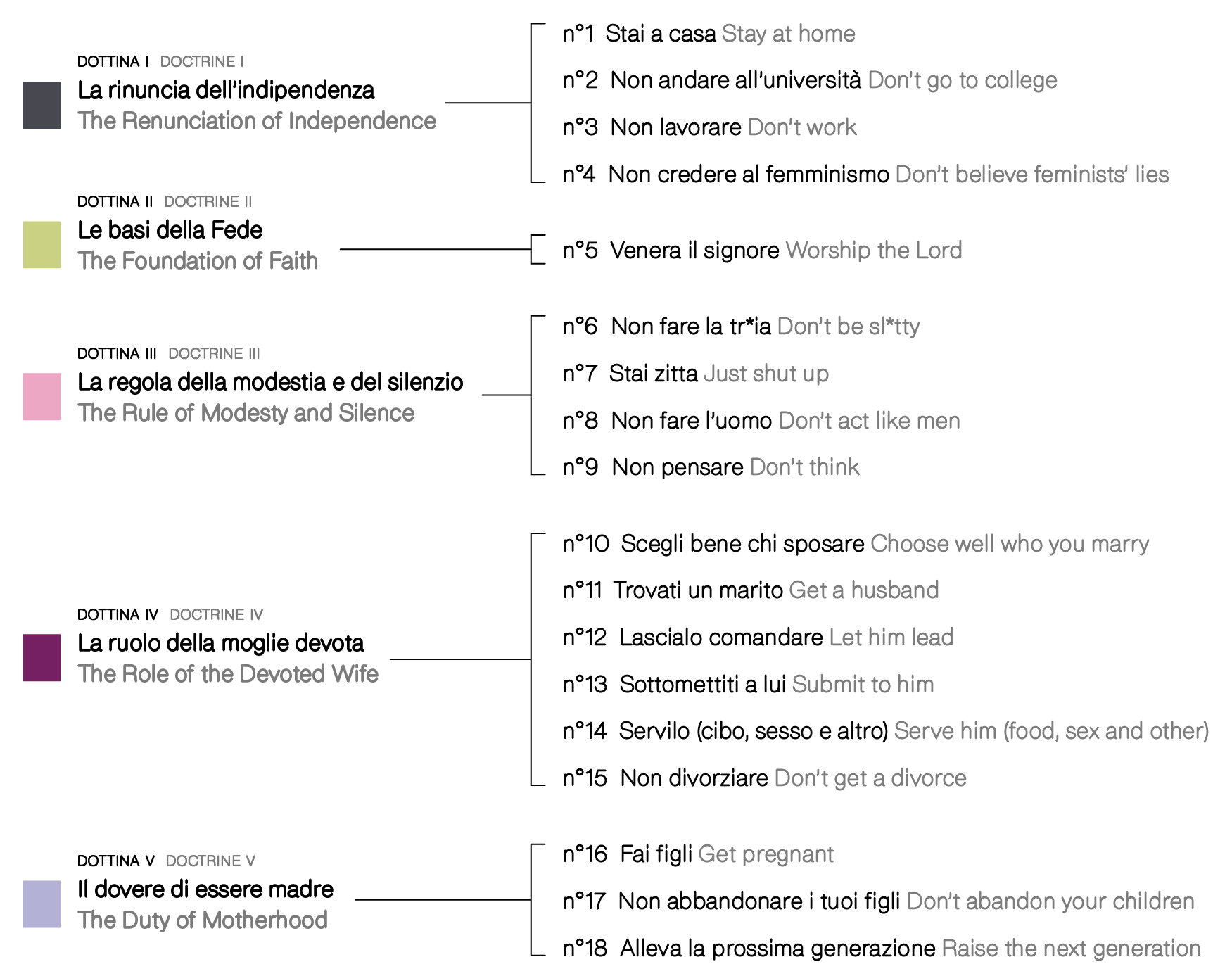
[Structure of the 5 doctrines in the “Commandments” collection]

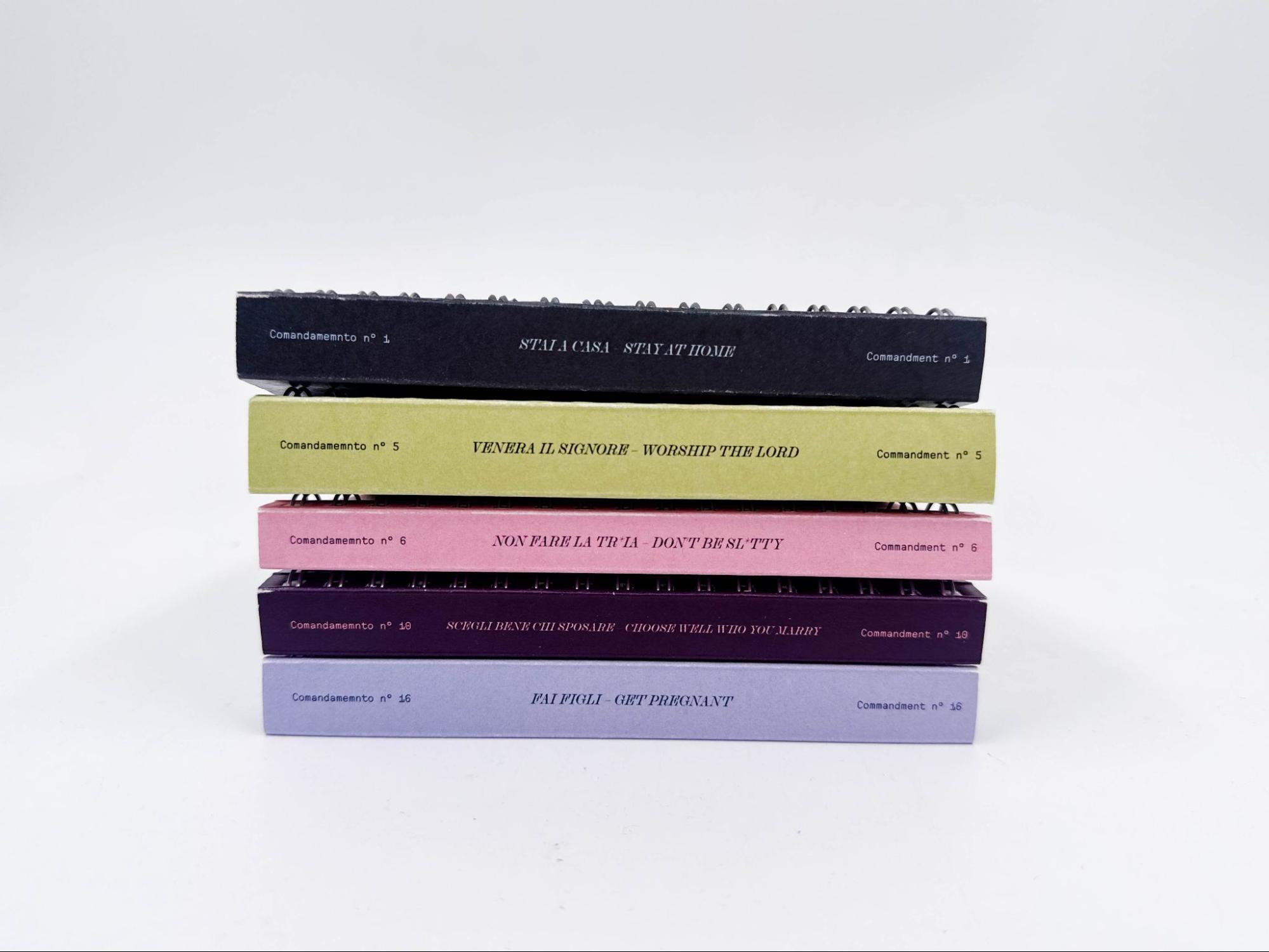
[Overview of covers in the “Commandments” collection; each color identifies one doctrine]
Each commandment takes the form of a catalog with a variable number of quotations but a fixed internal structure of three chapters, where extracted quotes are organized into subcategories and clusters.
Chapter 01 “Because...” collects claims that explain why women should follow a commandment.
Chapter 02 “So that...” gathers promised positive outcomes (emotional, relational, economic, or physical), framed as direct consequences of obedience.
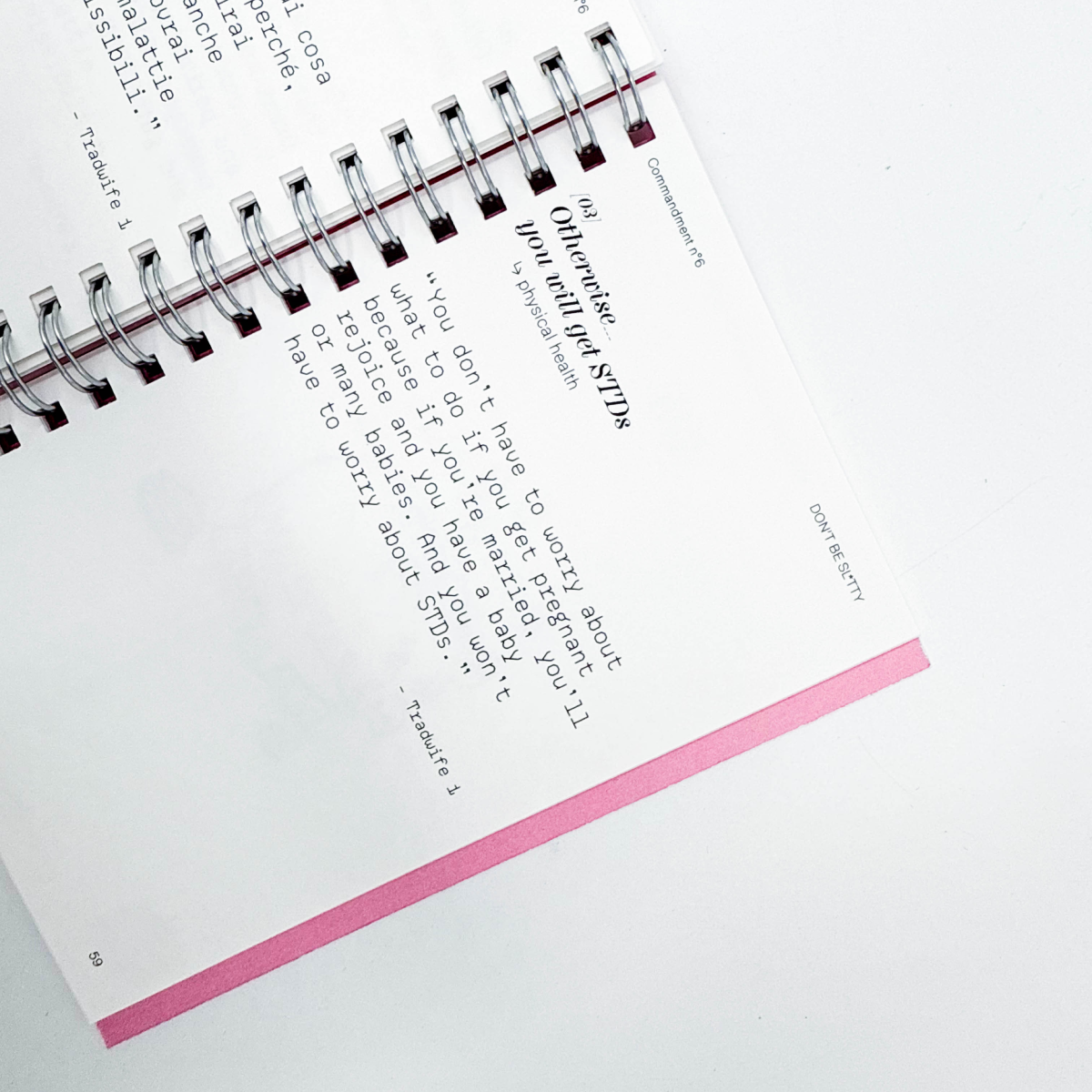
Chapter 03 “Otherwise...” collects claims linking non-adherence to negative outcomes such as personal failure, instability, or suffering.
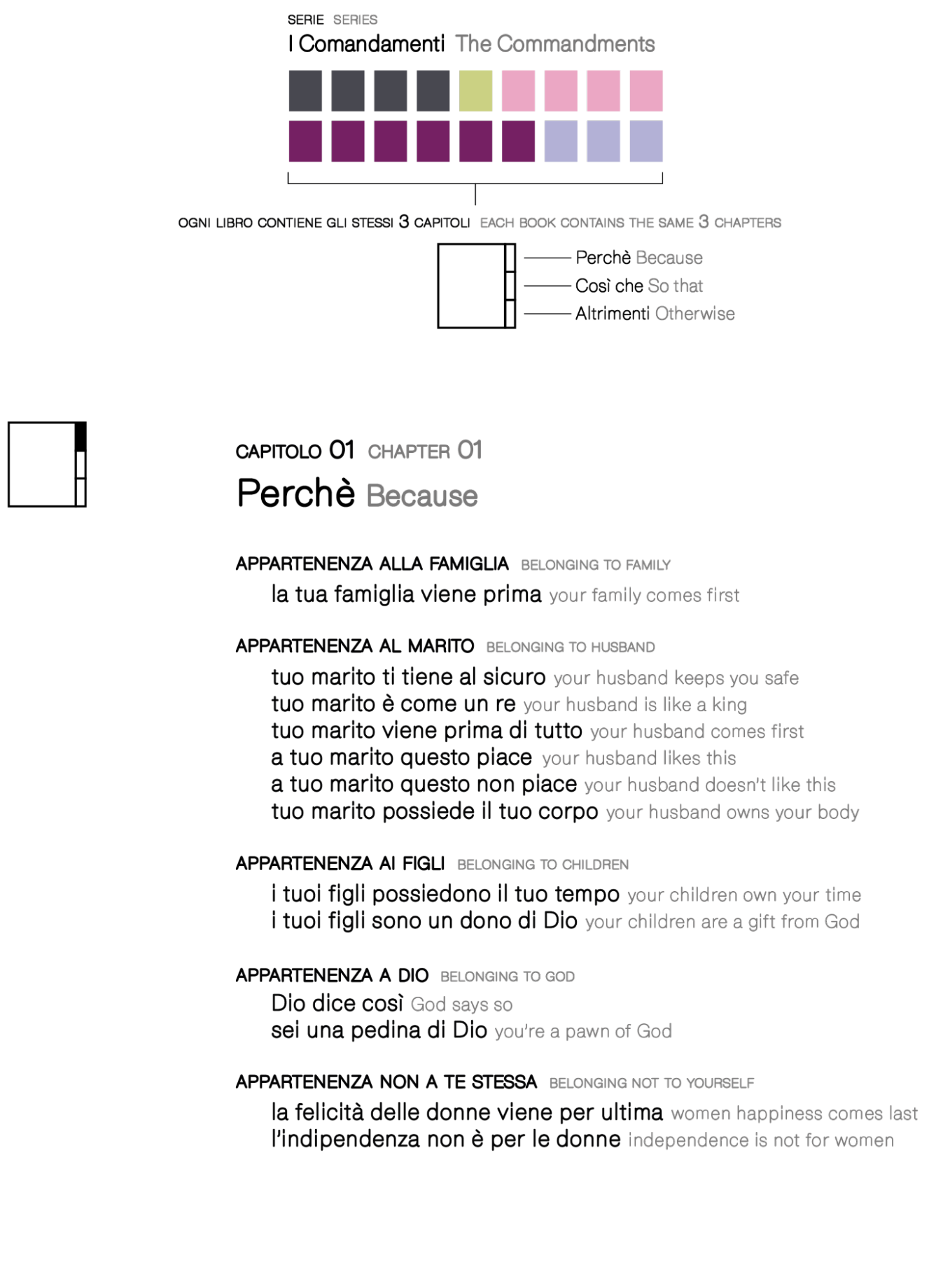

[Internal structure of books in the “Commandments” collection]

[Tabs distinguishing the 3 chapters inside each book]
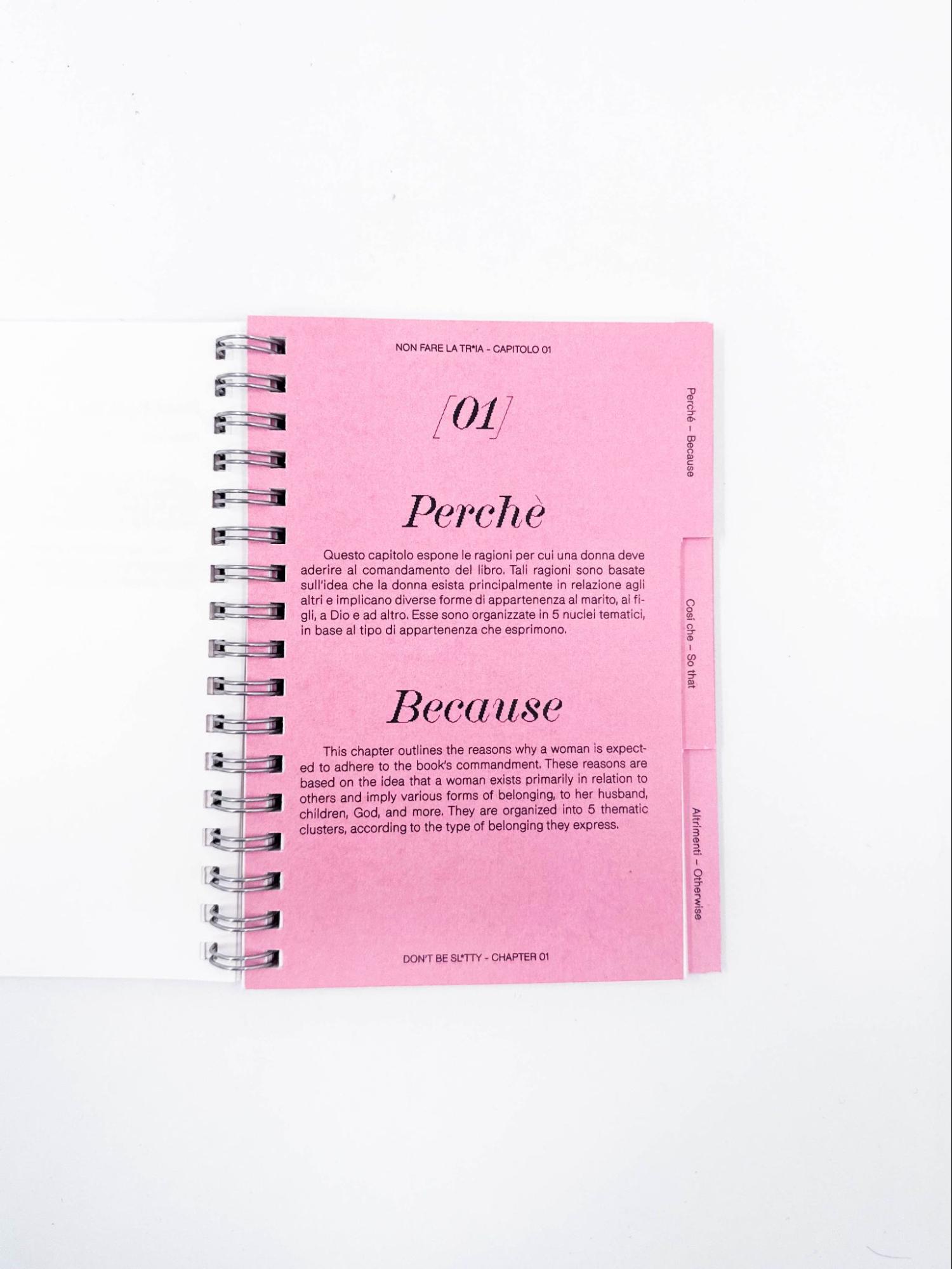
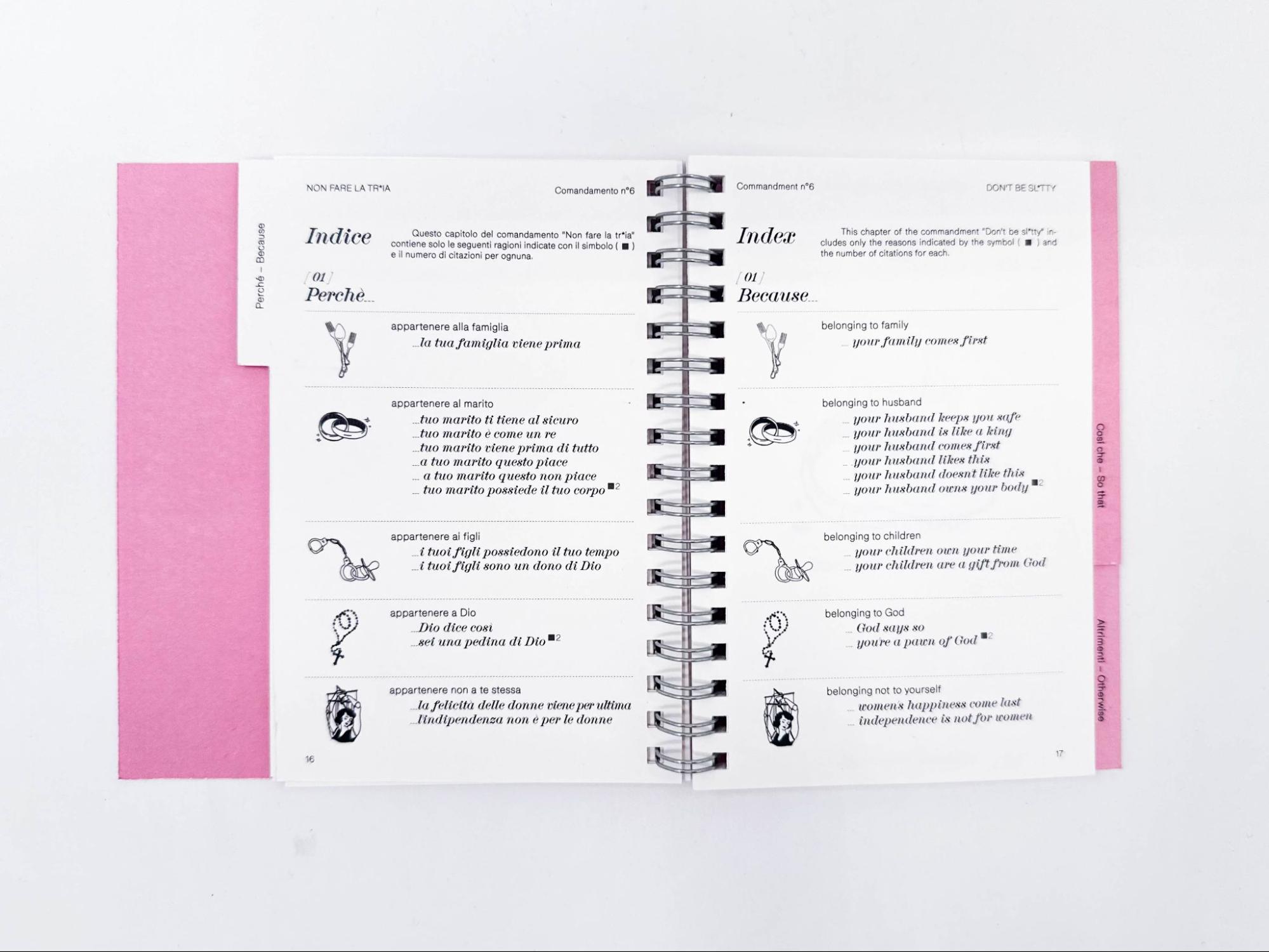
[Opening page and index of Chapter 01 “Because...”]
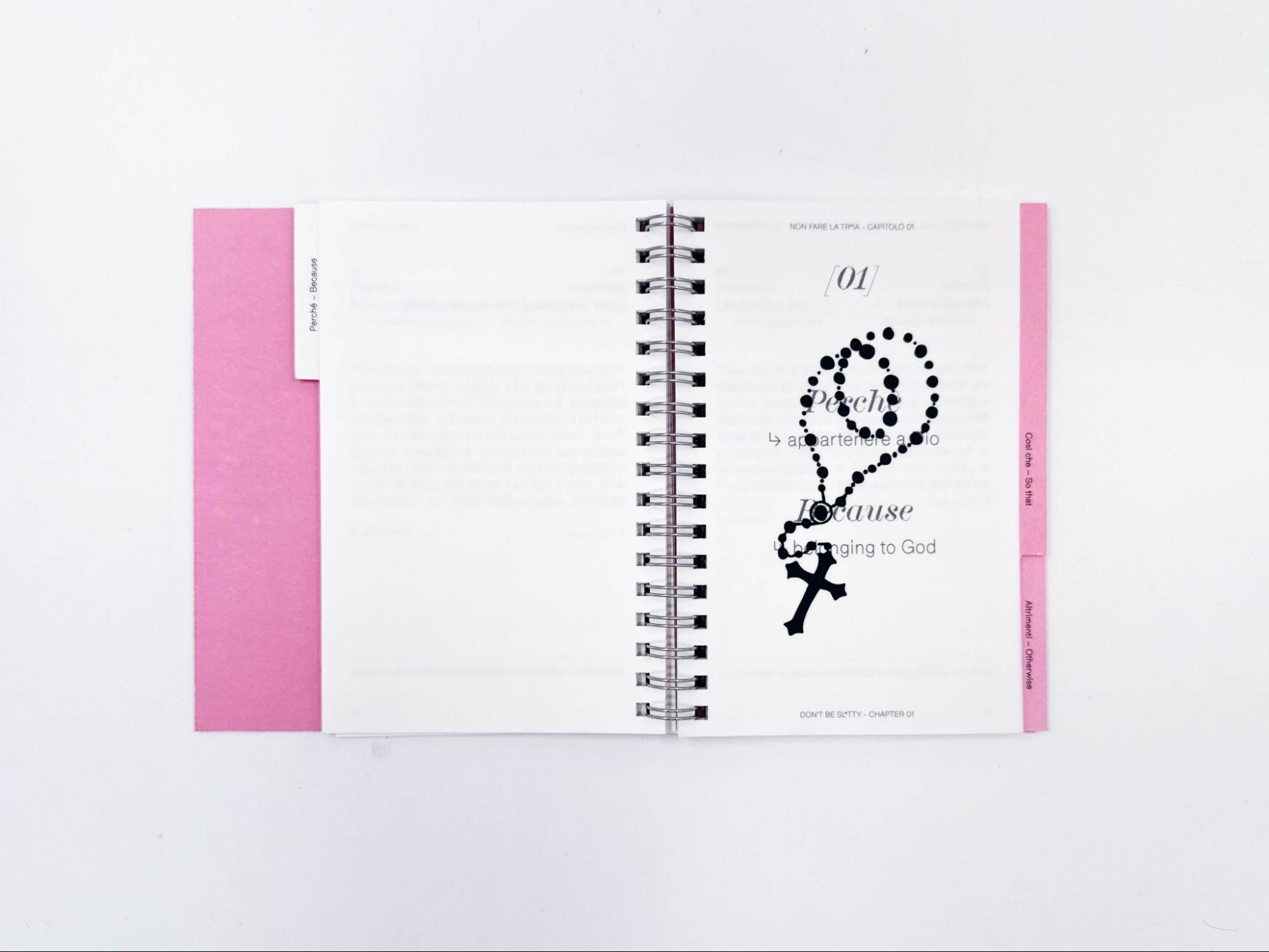
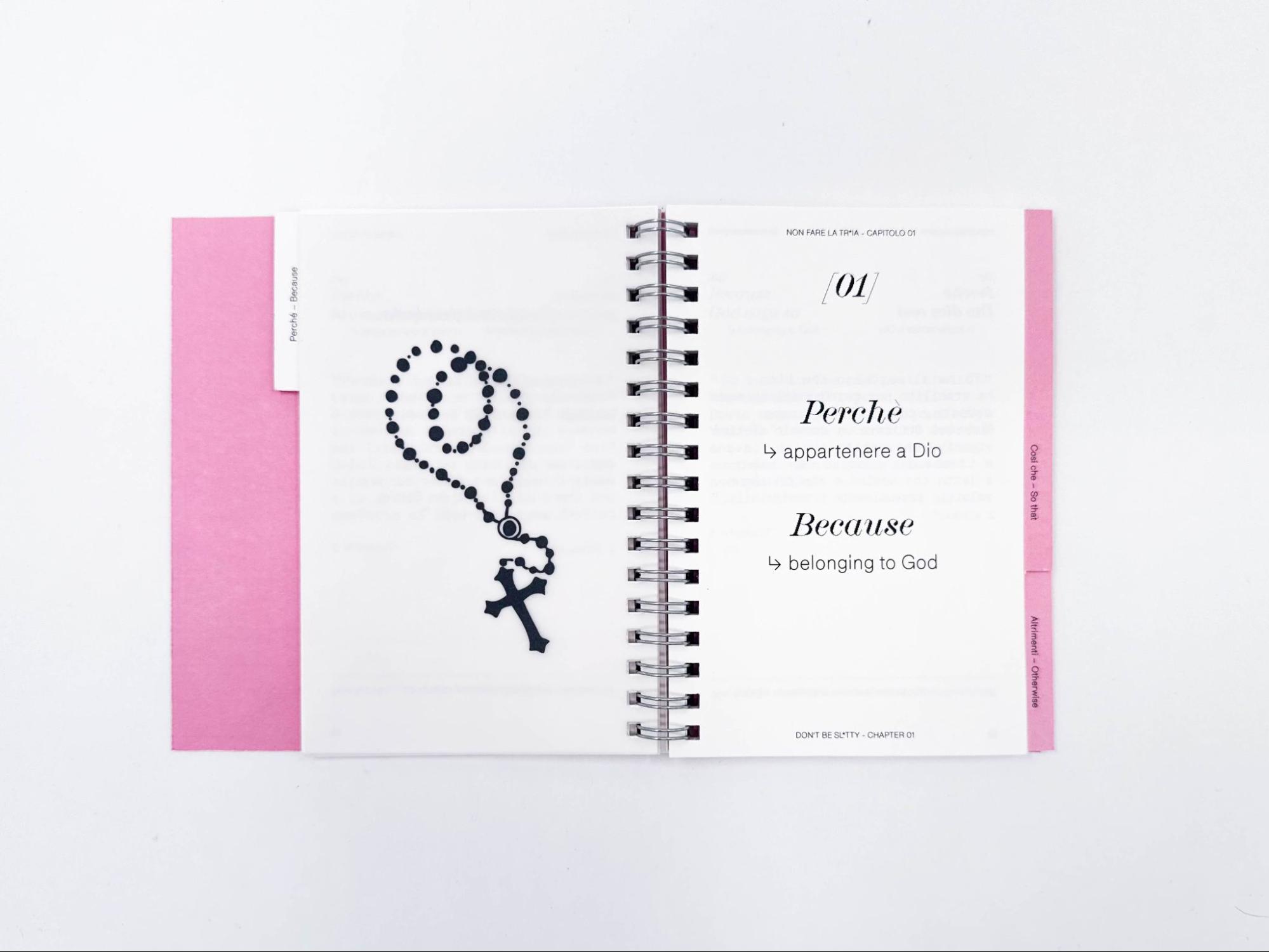
[Opening page of one cluster in Chapter 01 “Because...”]
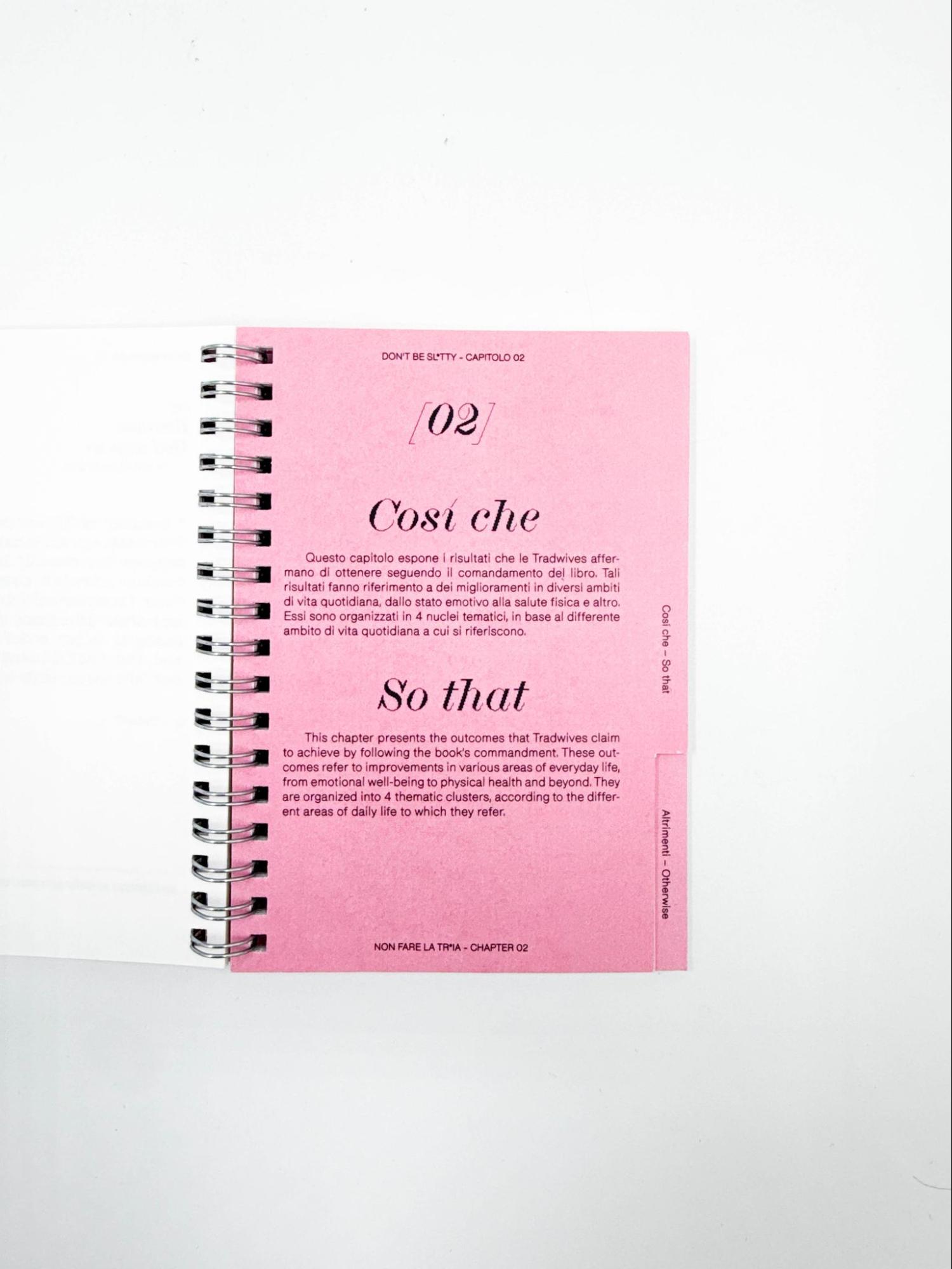
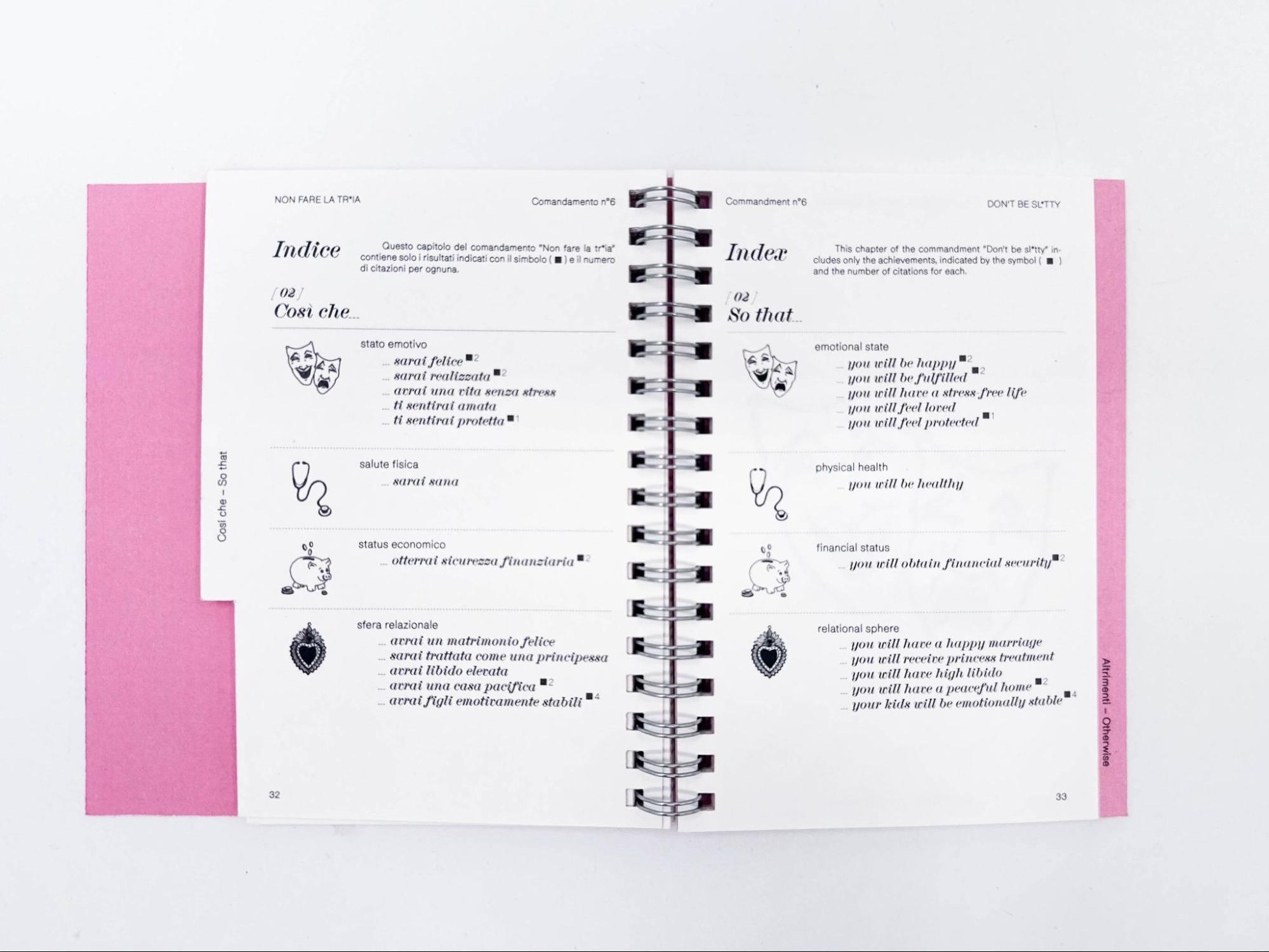
[Opening page and index of Chapter 02 “So that...”]
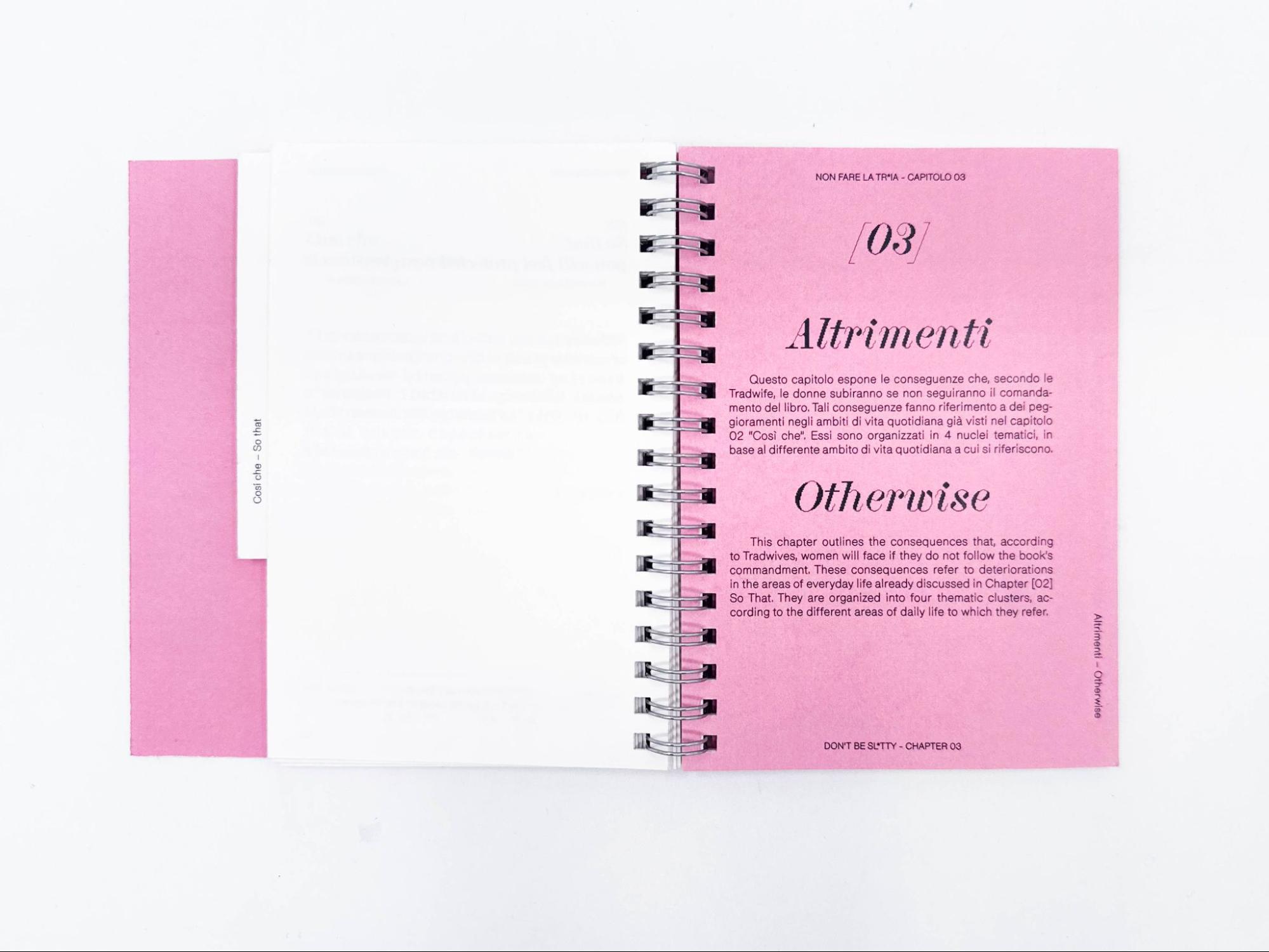
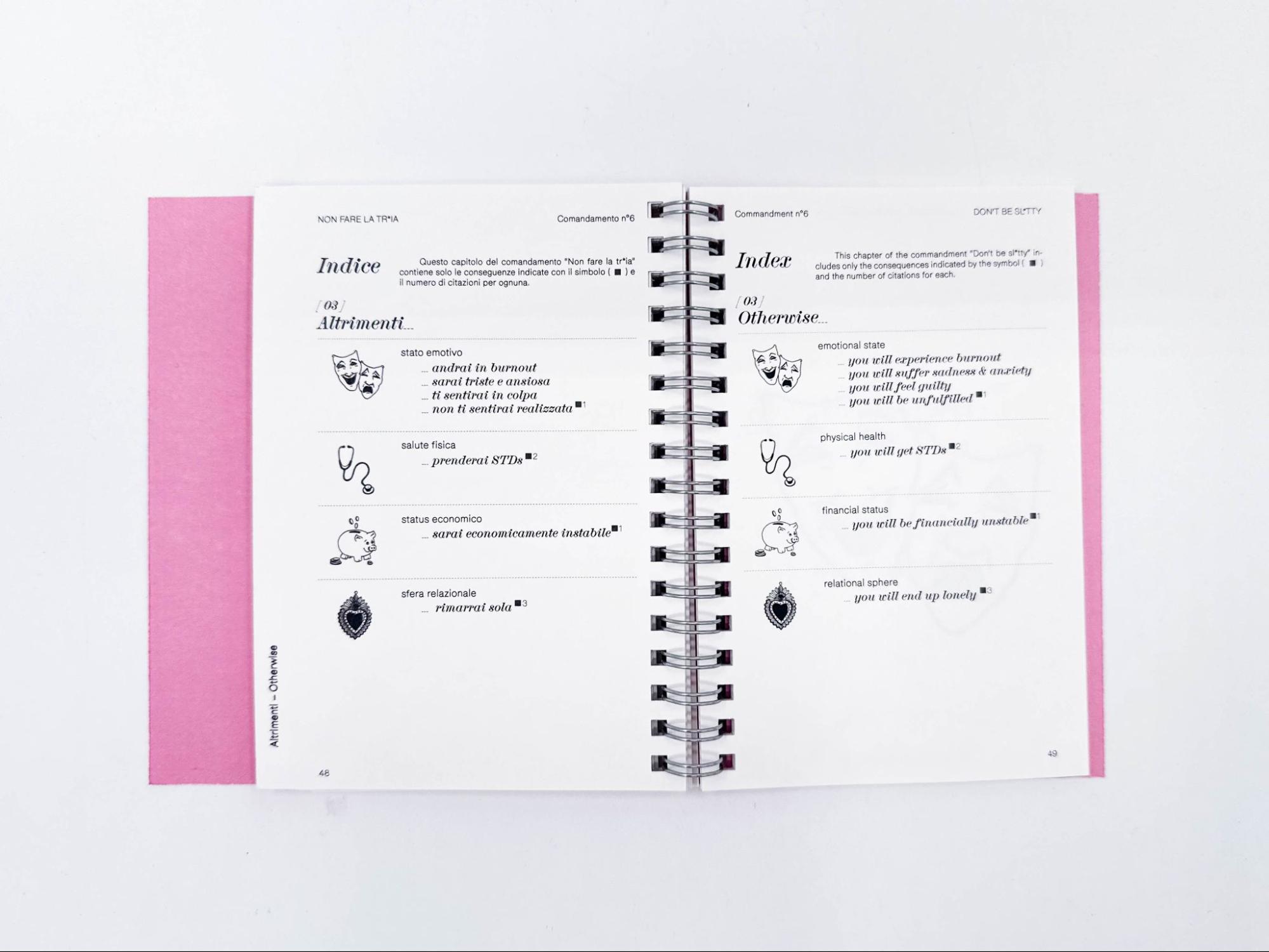
[Opening page and index of Chapter 03 “Otherwise...”]
Each spread contains one quotation (in English and Italian). A modular running head catalogs each quote with: Commandment + Chapter (Because... / So that... / Otherwise...) + Subcategory.
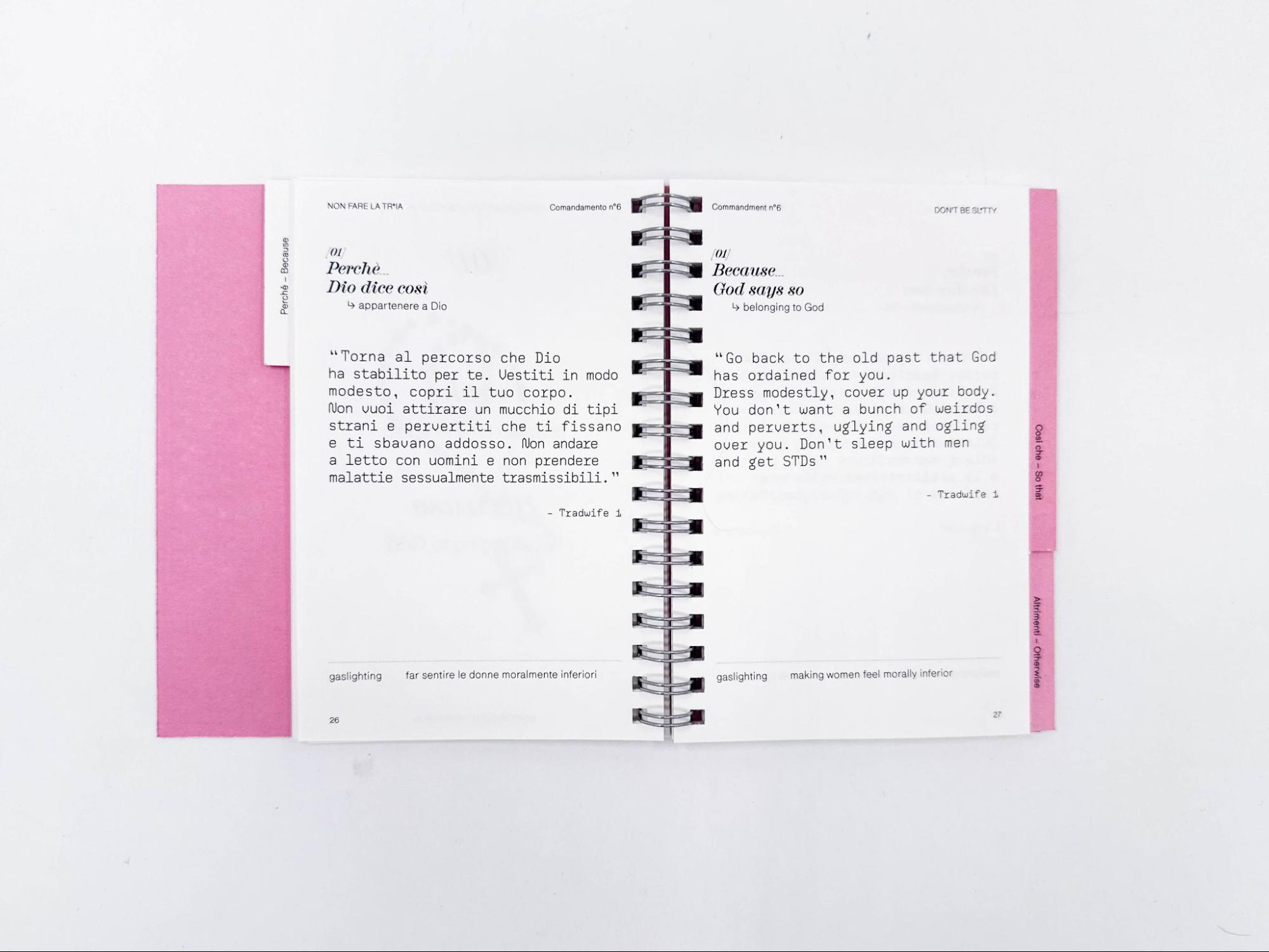
[Spread with bilingual quote and cataloging system]
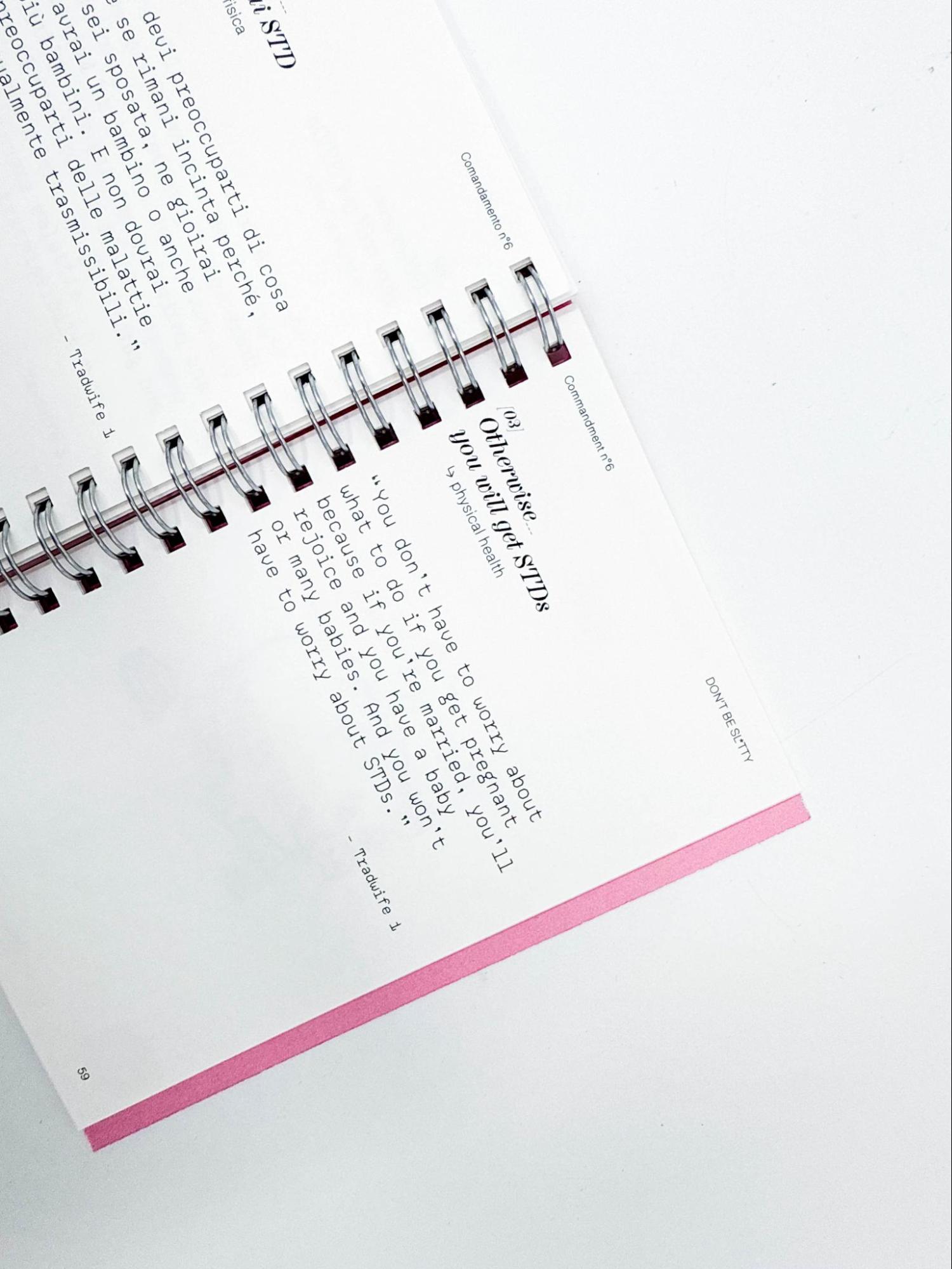
[Running head detail]
Some quotations include gaslighting rhetoric: language used to induce guilt and self-blame in potential listeners.
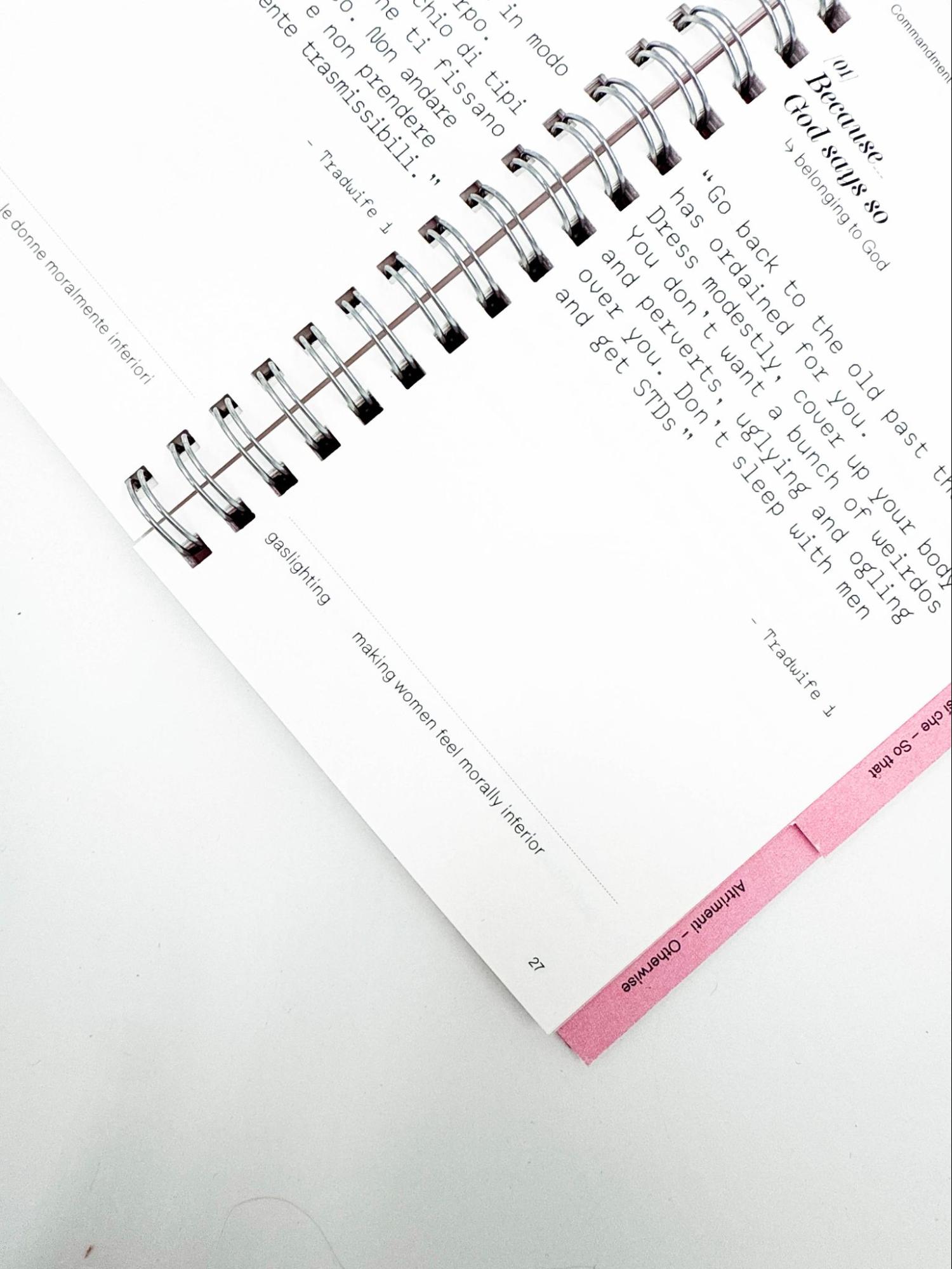
[Some quotes include gaslighting; the reference appears in the page footer]
Some quotations directly reference husbands and children. These references activate cross-links to the second collection, “Holy Cards,” made of two visual books: “Worthy Men” and “Perfect Children.” These collect and classify screenshots extracted from U.S. Tradwife TikTok videos, categorizing men and children by roles and actions. Cross-references between text and images show how the visual presence of these subjects supports and legitimizes the gender hierarchies promoted by the trend.


[Cross-link between “Commandments” and “Holy Cards” collections]
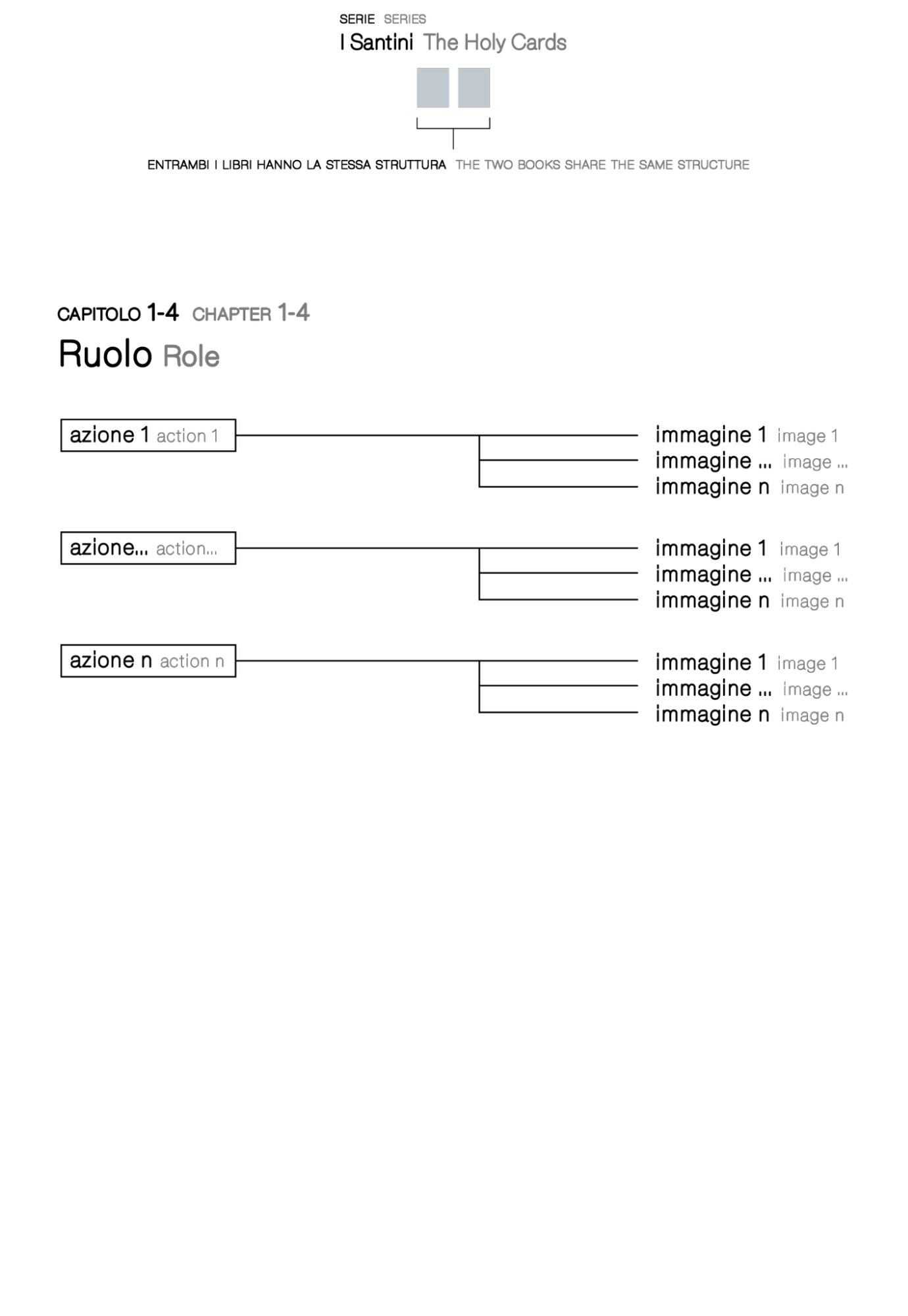
[Internal structure of books in the “Holy Cards” collection]
The imaginary built through Tradwife discourse and visuals reinforces traditional gender roles, presenting them as a peaceful solution to the frustration and frenzy of modern society.
Evaluation
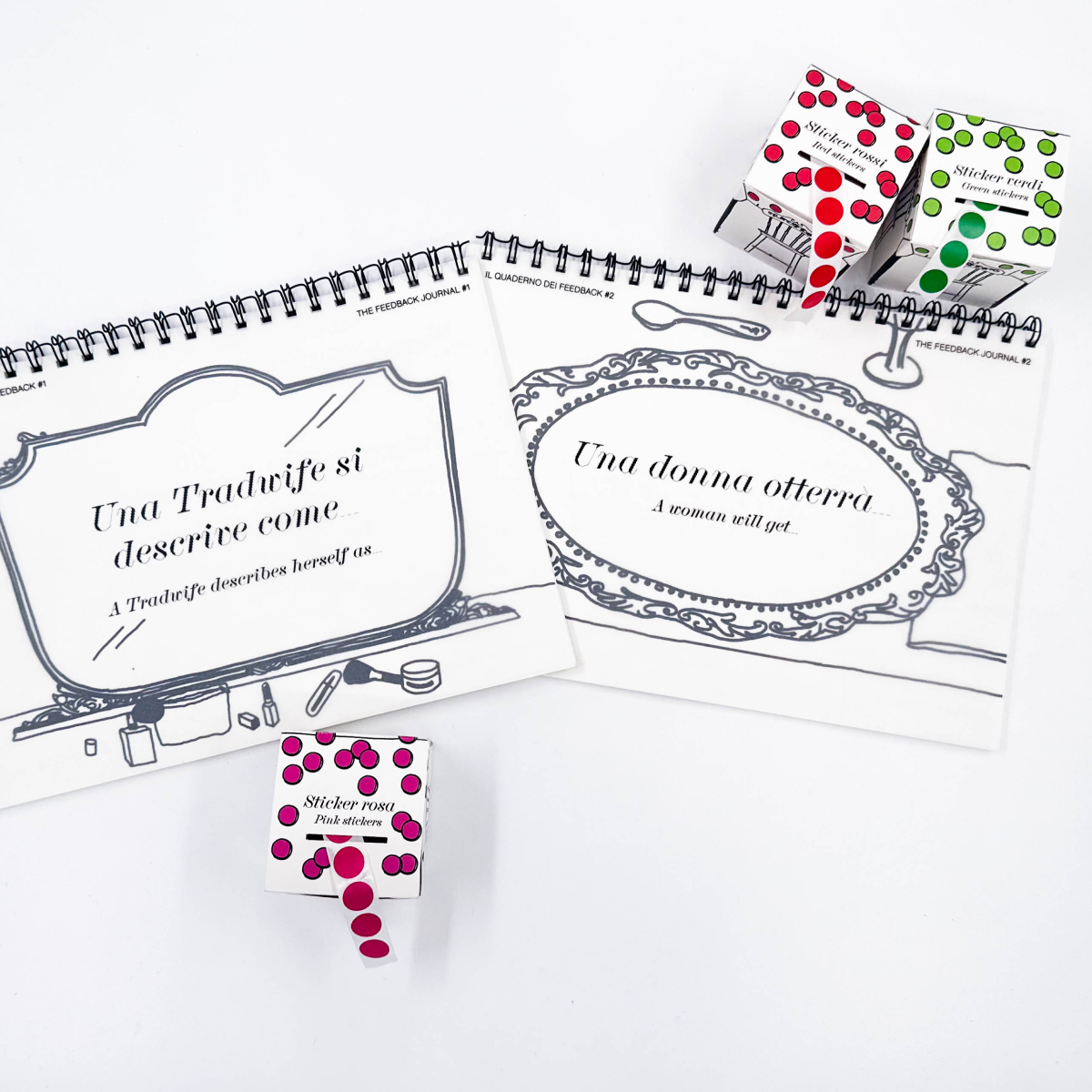
In the final part of the artifact, visitors take part in two short activities in the Feedback Notebooks at the end of the table. They are asked to complete two printed sentences by placing colored stickers next to definitions that best complete them. These activities highlight key ideas explored by the artifact: Tradwife identity is rooted in traditional gender roles and relational bonds, and according to this ideology every woman should follow this model to reach a “happy ending.”
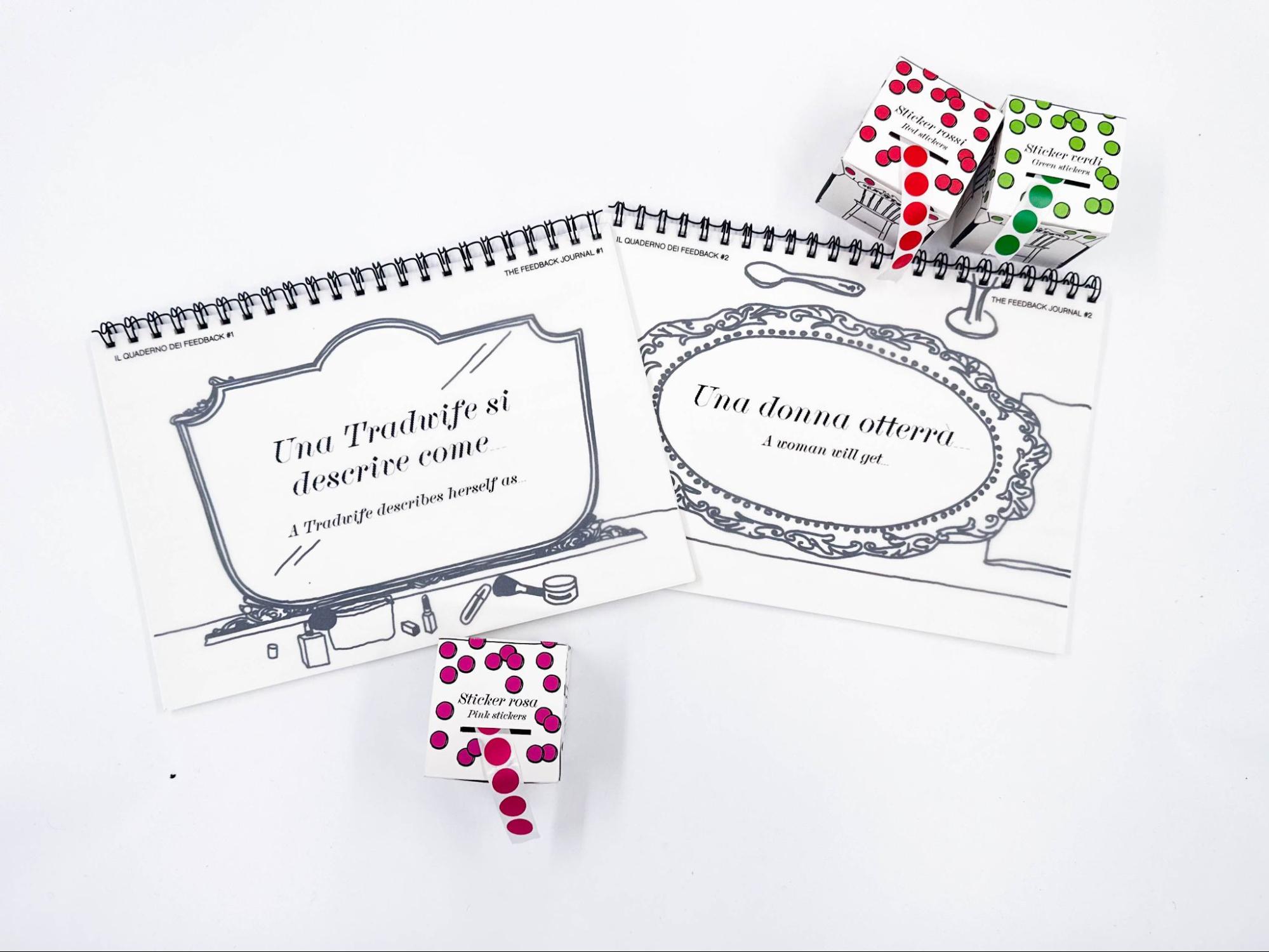
[The two Feedback Notebooks]
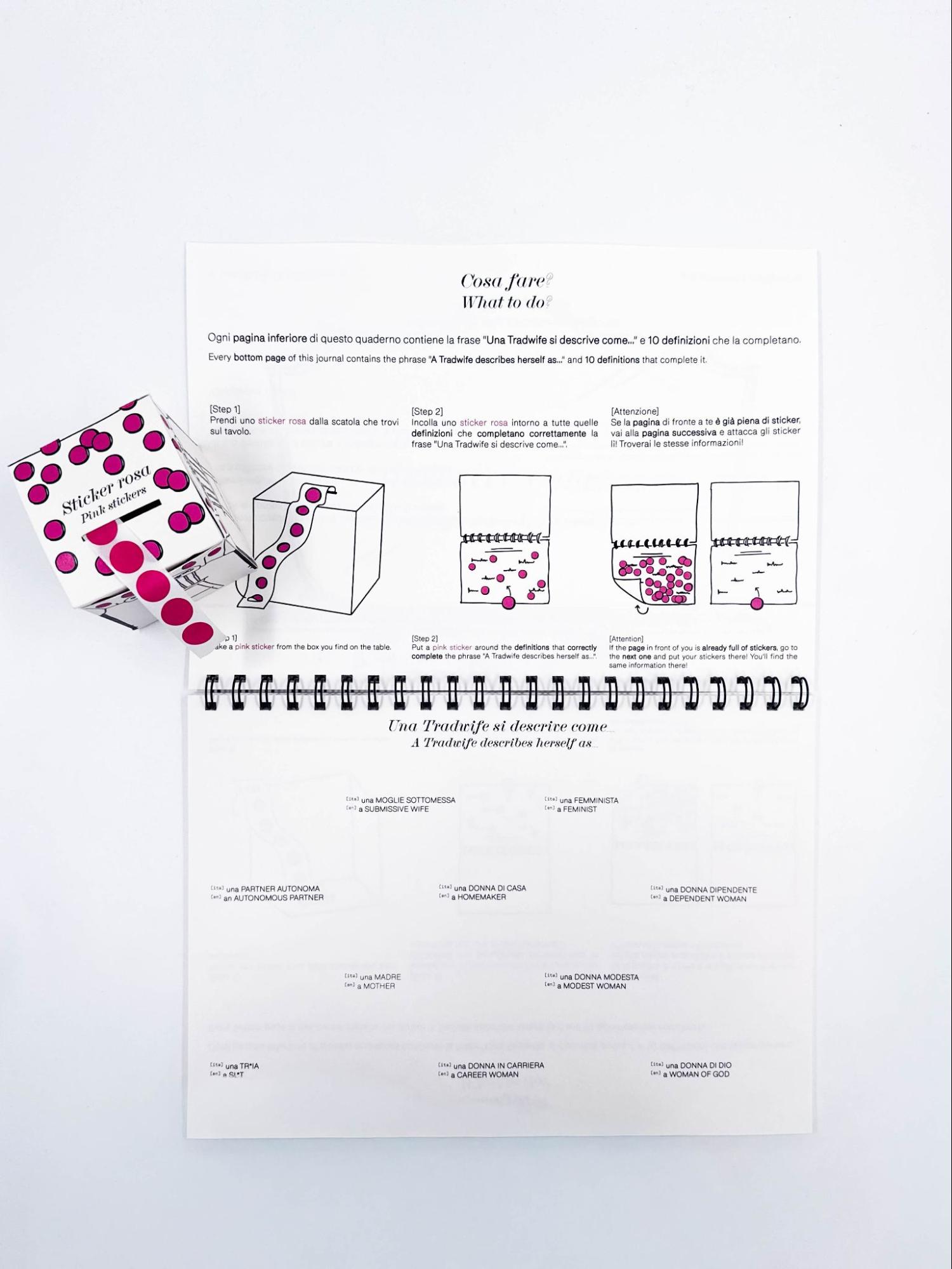
[Feedback Notebook #1 - instructions and activity]
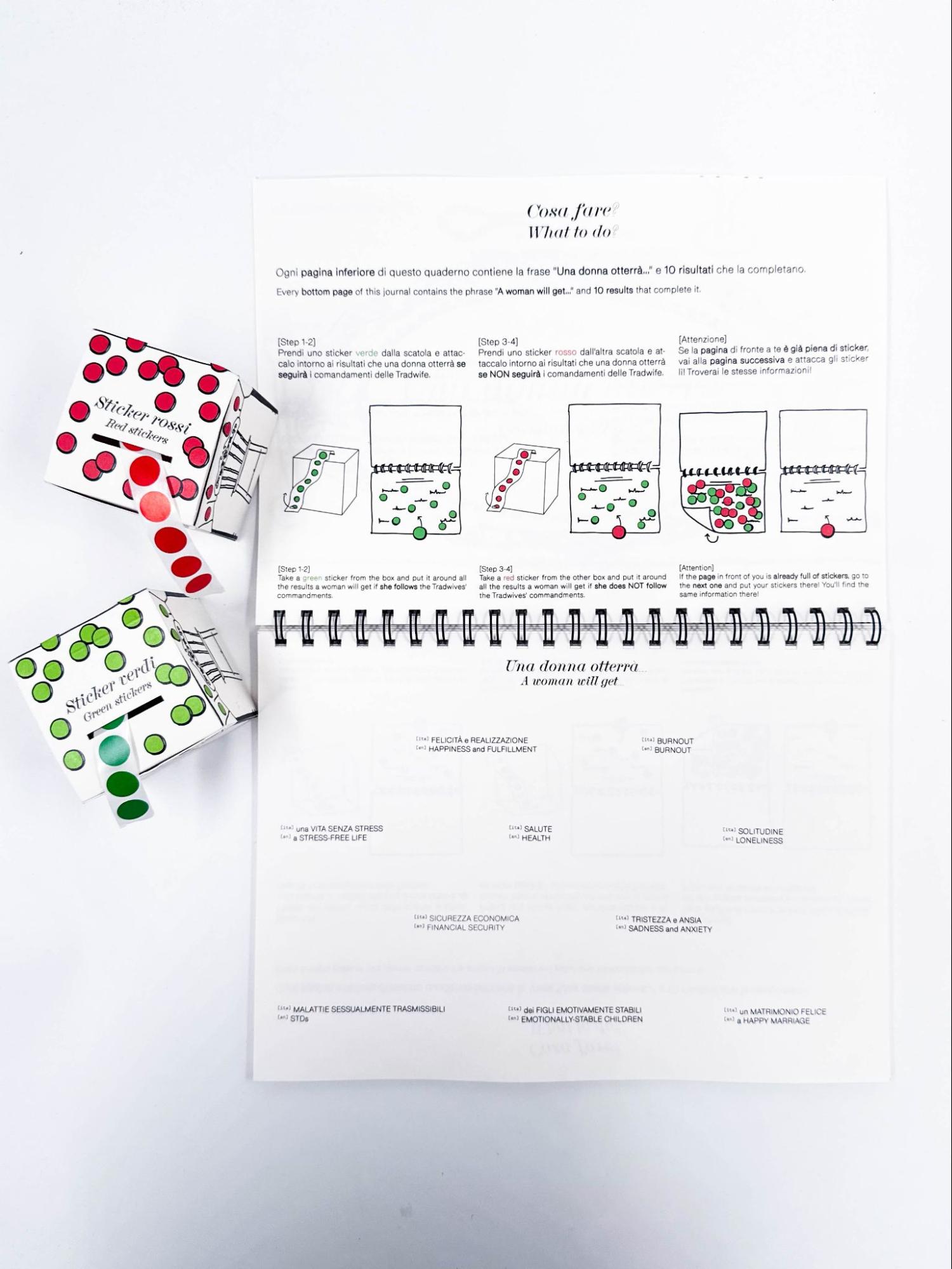
[Feedback Notebook #2 - instructions and activity]


